

Four Seasons Yachts: Redefining Luxury Ocean Travel
Now the emergence of Four Seasons Yachts has become one of the defining narratives in ultra-luxury travel, marking a pivotal evolution in how affluent travelers experience the sea. What began as a bold announcement in 2025 has now matured into a fully realized concept that blends the intimacy of superyachting with the rigor and consistency of a world-class hospitality brand. For the global readership of Yacht Review, which spans seasoned yacht owners, charter clients, family travelers, and industry leaders from North America, Europe, Asia, and beyond, Four Seasons Yachts represents not simply a new product but a new category at the intersection of yachting, design, and experiential travel.
At its core, the project is the result of a strategic collaboration between Four Seasons Hotels and Resorts, Marc-Henry Cruise Holdings Ltd., and Italian shipbuilding powerhouse Fincantieri. Together they have created a vessel-and ultimately a fleet-that aspires to meet the expectations of discerning travelers in the United States, United Kingdom, Germany, Canada, Australia, Italy, France, Spain, the Netherlands, Switzerland, China, Singapore, and other key luxury markets, who increasingly seek privacy, authenticity, and environmental responsibility alongside uncompromising comfort. Against this backdrop, Yacht Review continues to follow the development of Four Seasons Yachts closely, situating it within broader trends in reviews and new boats, design, business strategy, and sustainability that are reshaping the global yachting landscape.
A Vision Rooted in Hospitality Excellence
The vision behind Four Seasons Yachts has been orchestrated by Larry Pimentel, President and CEO of Marc-Henry Cruise Holdings, whose leadership history at Azamara, Oceania Cruises, and SeaDream Yacht Club has long positioned him as one of the most influential figures in boutique cruising. His collaboration with Four Seasons is not an attempt to replicate a cruise line model, but to craft an entirely new tier of ocean experience: fewer guests, more space, and a level of personalization more often associated with private yacht ownership than with scheduled voyages.
This concept is deeply aligned with the Four Seasons ethos that has been honed over decades across its portfolio of hotels, resorts, and residences in North America, Europe, Asia, Africa, and the Middle East. The company's reputation for intuitive, highly personalized service and its meticulous attention to detail provide the hospitality framework for the seaborne venture. For readers interested in how such strategic brand extensions are reshaping the maritime economy, the business section of Yacht Review explores how hospitality groups are diversifying into transport and experiential platforms, creating ecosystems that span land, sea, and, increasingly, private aviation.
Design and Engineering: A Superyacht Ethos at Resort Scale
The inaugural Four Seasons yacht, built by Fincantieri at its Ancona yard, exemplifies the convergence of superyacht aesthetics and small-ship engineering. With a length of approximately 207 meters and an investment exceeding $400 million, the vessel has been conceived not as a scaled-down cruise ship but as a scaled-up superyacht, with only 95 suites and a guest capacity far below what its tonnage could theoretically support. This deliberate underutilization of volume translates directly into space, privacy, and comfort.
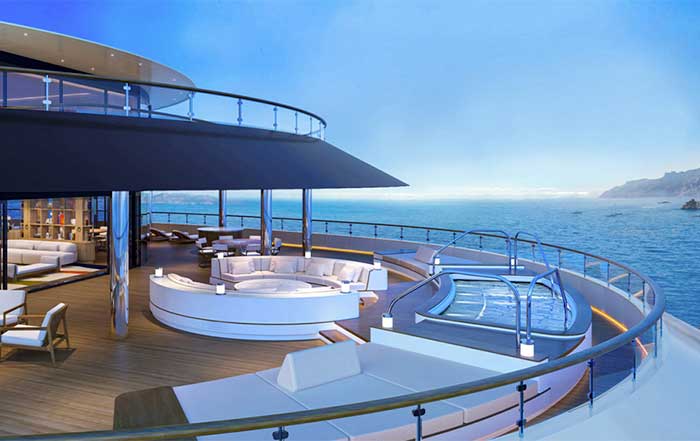
The interior and exterior design have been led by Tillberg Design of Sweden, working in collaboration with Martin Brudnizki Design Studio, both of which have extensive pedigrees in high-end maritime and hospitality design. Their shared brief has been to create a residential ambiance that feels more akin to a private villa overlooking the sea than to a conventional ship's interior. Suites average around 58 square meters, with many significantly larger, and each features floor-to-ceiling glass, expansive terraces, and a palette of natural materials-Italian marbles, Scandinavian woods, and fine linens-that subtly reference the yacht's itineraries in the Mediterranean, Caribbean, and beyond.
The Funnel Suite, spanning four decks and offering an unprecedented 280-degree viewline, has already attracted attention across the global yachting community as a new benchmark in maritime accommodation. Its private pool, spa area, and entertainment spaces are designed to function as a standalone residence within the vessel. For Yacht Review's audience, accustomed to tracking advances in yacht architecture and interior innovation, this project offers compelling case studies in space planning, materials, and the blending of hospitality and marine design, themes explored further in the magazine's dedicated design coverage.
Guest Experience: From Cruise Itinerary to Curated Lifestyle
What distinguishes Four Seasons Yachts most clearly from traditional cruising is its approach to the guest journey. Rather than designing a program around mass-market entertainment and fixed schedules, the brand has adopted a lifestyle-driven philosophy that mirrors the preferences of yacht owners and charter clients in key markets such as the United States, United Kingdom, Monaco, the French Riviera, the Balearics, the Caribbean, Southeast Asia, and the South Pacific.
Culinary programming is central to this approach. Four Seasons has leveraged its global network of Michelin-recognized chefs and culinary partners to create a suite of venues that reflect local terroir and seasonal availability. A Mediterranean fine-dining restaurant might highlight Amalfi citrus and Ligurian olive oil one week, while an omakase bar showcases line-caught fish from the Aegean the next. Menus are continually adapted to reflect local markets, fisheries, and vineyards, aligning with broader shifts in gastronomy toward locality and sustainability. Readers interested in how food and beverage concepts contribute to lifestyle differentiation at sea can explore the lifestyle section of Yacht Review, where culinary trends and onboard experiences are examined through a yachting lens.
Wellness is treated with similar depth. The onboard spa integrates Four Seasons' established treatment philosophies with marine-inspired therapies, incorporating ingredients like seaweed, mineral-rich salts, and botanicals sourced from coastal regions. Facilities include a comprehensive fitness center, open-air movement decks for yoga and Pilates, and saltwater infinity pools that visually merge with the surrounding seascape. This alignment between wellness, environment, and design reflects a broader trend in the global travel market, where high-net-worth guests increasingly prioritize longevity, mental health, and restorative experiences over conspicuous consumption.
Itineraries and Destination Strategy: Access Over Scale
Four Seasons Yachts has been conceived for travelers who value access, intimacy, and depth of experience over breadth of coverage or shipboard spectacle. The itineraries, which initially focus on the Mediterranean and Caribbean but are expected to expand into Northern Europe, Asia, and the South Pacific, are curated around ports and anchorages that are often inaccessible to larger vessels. In Europe, these include historic harbors along the Amalfi Coast, the Dalmatian islands, the Balearics, and the Greek archipelagos, while in the Caribbean, emphasis is placed on islands such as St. Lucia, Bequia, and select Bahamian cays.
Each voyage is structured not simply as a sequence of stops but as a narrative arc that balances cultural immersion, natural beauty, and personal downtime. Guests may participate in private vineyard visits in Tuscany, artisan-led workshops in Sicily, or archaeological tours in Greece, often outside regular public hours. In the Caribbean, curated experiences might include reef-friendly snorkeling expeditions guided by marine biologists or visits to local communities engaged in sustainable fishing and agriculture. For Yacht Review readers who follow evolving destination trends and emerging yachting hubs-from Norway's fjords to Thailand's islands and New Zealand's remote bays-the magazine's global and travel sections provide additional context on how operators are differentiating itineraries in a crowded marketplace.
Sustainability as Strategic Imperative
By 2026, environmental performance is no longer a peripheral consideration but a core metric of credibility in the luxury yachting and cruising segments. Four Seasons Yachts has positioned itself among the leaders of this shift by integrating sustainability into the vessel's architecture, operations, and guest programming from the outset. The yacht employs advanced propulsion technologies, including hybrid systems designed to reduce fuel consumption and emissions, alongside optimized hull forms and next-generation stabilization that improve hydrodynamic efficiency.
Compliance with IMO Tier III standards for nitrogen oxide emissions is a baseline, not a marketing point, and the ship's waste management, water treatment, and energy recovery systems are engineered to exceed many regulatory requirements in Europe and North America. Materials selection-ranging from sustainably sourced timber to recycled metals and low-impact fabrics-reflects a philosophy of responsible luxury that is increasingly expected by sophisticated travelers in markets such as Germany, Scandinavia, Switzerland, and Japan, where environmental awareness is particularly high. Those wishing to understand the broader regulatory and technological context can consult organizations such as the International Maritime Organization and track classification guidelines through entities like DNV.
Beyond hardware, Four Seasons Yachts is developing partnerships with marine conservation groups and local NGOs to support coral restoration, seagrass protection, and coastal resilience projects in regions like the Caribbean, Mediterranean, and Southeast Asia. Guests are invited to engage with these initiatives through educational briefings, site visits, and citizen-science activities, transforming the voyage into an opportunity for meaningful contribution rather than passive observation. Yacht Review covers many of these developments in its sustainability coverage, where the focus is on practical innovation, regulatory evolution, and the business case for greener operations across the yacht and small-ship sectors.
Partnerships and Business Model: A New Maritime Ecosystem
The partnership structure underlying Four Seasons Yachts is itself an important development for the global maritime industry. Marc-Henry Cruise Holdings serves as the maritime operating company, responsible for technical management, navigation, and regulatory compliance, drawing on decades of small-ship and yacht-cruise experience. Four Seasons Hotels and Resorts provides the hospitality blueprint, brand standards, and training methodologies that underpin the onboard service culture. Fincantieri, one of Europe's largest and most respected shipbuilders, delivers the physical platform, integrating advanced shipbuilding technologies with the design team's aesthetic vision.
This tripartite model reflects a broader shift in which hospitality brands, shipyards, and investment partners collaborate more closely to create vertically integrated experiences that extend from booking and pre-arrival services to post-voyage engagement. For investors and executives across the United States, Europe, Asia, and the Middle East, such ventures illustrate how capital-intensive maritime assets can be de-risked through strong brand affiliation and diversified revenue streams, from charter and full-ship buyouts to hybrid land-sea itineraries. Yacht Review's business analysis continues to follow these developments, comparing Four Seasons Yachts with similar initiatives from other luxury hotel brands and private equity-backed operators.
Technology and Connectivity: Intelligent Luxury at Sea
While the visual and experiential aspects of Four Seasons Yachts attract the most attention, the project's technological underpinnings are equally significant. The vessel employs integrated smart systems that manage climate control, lighting, shading, and entertainment within each suite and public area, all accessible through a unified digital interface. Guests can customize their environment, schedule in-suite dining, book spa treatments, or arrange private shore excursions through a dedicated Four Seasons application, which synchronizes with the brand's global customer relationship systems.
High-bandwidth satellite connectivity ensures that guests can conduct business, participate in video conferences, or access cloud-based services from virtually anywhere along the itinerary, a feature particularly valued by North American, European, and Asian executives who cannot fully disconnect for extended periods. For those interested in the technical backbone of such capabilities, resources like Inmarsat and SES provide insights into the satellite networks and maritime connectivity solutions that make this level of service possible. Yacht Review explores these themes in more depth within its technology section, where automation, cybersecurity, and digital guest experience are recurring topics.
Crew, Culture, and the Human Dimension of Luxury
However advanced the vessel's hardware and software may be, Four Seasons Yachts ultimately depends on the expertise and emotional intelligence of its crew to deliver on its promise. Recruitment has focused on professionals with backgrounds in both high-end hospitality and maritime operations, including captains with extensive experience in complex cruising regions, hotel managers from flagship Four Seasons properties, and specialists in wine, wellness, and destination management. Training programs are run in conjunction with Four Seasons University, adapted to the unique demands of life at sea and the brand's commitment to anticipatory service.
The crew-to-guest ratio is intentionally high, enabling a level of recognition and personalization that is difficult to achieve on larger vessels. Over the course of a voyage, guests are known by name and preference, whether that means a specific coffee preparation at breakfast, a favored yoga schedule, or a discreet approach to privacy. This human-centric philosophy aligns with the broader trend in luxury travel toward relational, rather than transactional, service. For Yacht Review's community of owners, captains, and senior crew, the human side of maritime excellence is an ongoing area of interest, reflected in the magazine's community coverage and profiles of industry professionals.
Family, Multi-Generational, and Charter Appeal
Four Seasons Yachts has been crafted not only for couples and solo travelers but also for families and multi-generational groups from regions as diverse as North America, Europe, Asia, and Australasia. Suite configurations allow for flexible combinations that can accommodate parents, children, and grandparents in adjacent or interconnected spaces, while still preserving privacy. Onboard programming includes educational workshops focused on marine biology, navigation, and local culture, giving younger guests meaningful engagement with the destinations they visit.
For families accustomed to villa rentals in the Mediterranean, ski chalets in the Alps, or safari lodges in Africa, the yacht offers a comparable sense of seclusion and togetherness, but with the added dimension of movement and discovery. The model is particularly attractive for full-ship charters, corporate retreats, and private events, where the vessel becomes a customizable environment for celebrations, product launches, or strategic gatherings. Yacht Review addresses these emerging patterns in its family and events coverage, analyzing how operators are adapting hardware and programming to support more complex group dynamics.
Positioning Within the Global Yachting and Travel Ecosystem
By 2026, Four Seasons Yachts exists within a competitive and rapidly evolving landscape. The growth of ultra-luxury expedition vessels, the expansion of yacht-like small-ship fleets, and the increasing sophistication of private yacht charter offerings have all raised expectations among high-net-worth travelers from the United States, United Kingdom, Germany, China, Singapore, the Gulf states, and beyond. In this context, Four Seasons Yachts differentiates itself through the strength of its hospitality brand, the depth of its design and engineering partnerships, and its ability to integrate seamlessly with the broader Four Seasons ecosystem of hotels, resorts, and private residences.
This integration enables guests to construct multi-stage journeys that might begin at Four Seasons Athens, continue through a week-long Adriatic sailing, and conclude at Four Seasons Istanbul; or combine a Caribbean voyage with a stay at Four Seasons Nevis. Such combinations resonate strongly with global travelers who see travel not as a series of isolated trips, but as a continuous narrative of experiences across continents and seasons. Readers interested in how this evolution is reflected in the broader yacht and small-ship market can explore Yacht Review's reviews and news sections, where new launches, refits, and brand extensions are analyzed from both technical and experiential perspectives.
Four Seasons Yachts and Yacht Review: A Shared Focus on Experience and Integrity
For Yacht Review, Four Seasons Yachts is more than a compelling subject; it is a case study in how Experience, Expertise, Authoritativeness, and Trustworthiness can be brought together in a single maritime project. The brand's entry into ocean travel underscores many of the themes that have defined Yacht Review's editorial direction since its inception: the importance of design integrity, the role of technology in supporting-not overwhelming-the guest experience, the necessity of environmental responsibility, and the enduring appeal of the sea as a setting for personal transformation.
As the vessel begins to welcome guests from around the world-whether from New York or London, Zurich or Singapore, Sydney-Yacht Review will continue to evaluate its performance not only through the lens of luxury, but also through the criteria that matter most to an informed, global audience: build quality, operational reliability, sustainability metrics, and the authenticity of the experiences delivered on board and ashore. Readers can follow ongoing coverage through the magazine's cruising and history sections, where Four Seasons Yachts is placed within the broader continuum of ocean travel, from the golden age of liners to today's hybrid yacht-resort concepts.
End Summary: A New Horizon for Luxury at Sea
Four Seasons Yachts stands as a symbol of how the boundaries between hotels, yachts, and small ships are dissolving, giving rise to new forms of travel that combine the best attributes of each. By uniting the hospitality expertise of Four Seasons Hotels and Resorts, the maritime acumen of Marc-Henry Cruise Holdings, and the engineering prowess of Fincantieri, the project has created a vessel that aspires to set a new global benchmark in comfort, sustainability, and experiential depth.
For the sophisticated audience of Yacht Review, whether based in North America, Europe, Asia, Africa, or South America, Four Seasons Yachts offers a compelling illustration of where the industry is heading: toward smaller guest counts, higher design standards, deeper cultural engagement, and a more serious commitment to environmental stewardship. It is a direction that aligns closely with the values and expectations of a new generation of travelers who see the sea not only as a playground, but as a space for reflection, connection, and responsibility.
As Yacht Review continues to chronicle this evolution across its coverage of boats, technology, sustainability, lifestyle, and global cruising trends, Four Seasons Yachts will remain a touchstone-a reference point against which future projects in the ultra-luxury segment will inevitably be measured.