

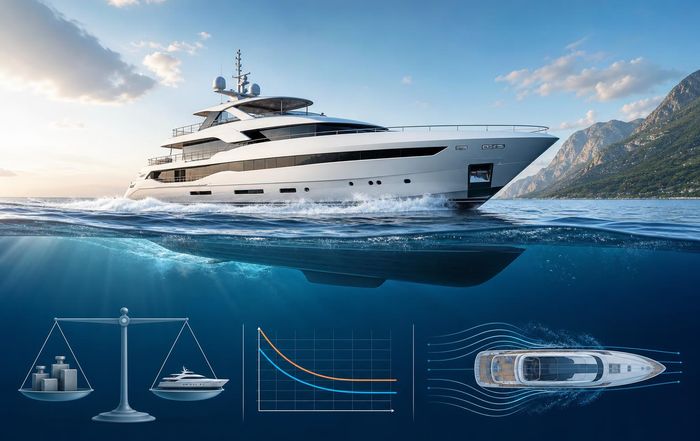
How Yacht Weight Influences Range and Performance
Yacht owners, captains and designers have long understood that weight is one of the most powerful levers in determining how a vessel behaves at sea, yet the full implications of displacement on range, efficiency, comfort and long-term value are still evolving as technology, regulation and owner expectations change. For the boat loving community here, weight is no longer just a naval-architecture variable; it is a strategic factor that shapes acquisition decisions, refit priorities, operational budgets and even charter market positioning.
This article examines how yacht weight influences range and performance across contemporary motor and sailing yachts, drawing on developments in hydrodynamics, materials science, propulsion and regulatory frameworks. It focuses on practical, decision-oriented insight for owners, family offices, project managers and industry professionals who need to balance comfort and luxury against efficiency, sustainability and long-term asset value.
Understanding Yacht Weight: Displacement, Deadweight and Load
In technical terms, a yacht's "weight" is typically referred to as displacement, the total mass of water the hull displaces when afloat, which equals the vessel's own mass. Naval architects distinguish between lightship displacement, which includes the yacht and its fixed systems but not fuel, water, stores or people, and full-load displacement, which adds all variable loads that change from voyage to voyage.
Deadweight, a related concept more common in commercial shipping, refers to the mass of fuel, fresh water, provisions, tenders, toys, crew, guests and consumables. On a superyacht, this variable load can be very substantial, especially when long-range cruising requires full fuel tanks and extensive provisioning, and when large tenders and submersibles are carried in garages or on decks. The difference between lightship and full-load displacement can reach several hundred tonnes on large yachts, with measurable consequences for draft, speed and fuel burn.
Designers at leading studios such as Feadship De Voogt Naval Architects, Lürssen Yachts and Benetti have repeatedly emphasized in interviews and technical papers that managing weight growth through the design and construction process is one of their primary challenges, because every additional kilogram must be pushed through the water, lifted over waves and accelerated repeatedly. As regulatory and comfort requirements increase, controlling this tendency toward displacement creep is vital to preserving the intended performance profile.
Readers interested in how different builders reconcile these trade-offs can find comparative perspectives in the long-form yacht evaluations in the reviews section, where real-world performance against design targets is often discussed.
Hydrodynamics: Why Extra Weight Costs Speed and Fuel
From a hydrodynamic standpoint, weight influences both the resistance a yacht experiences moving through water and the way it interacts with waves. For displacement and semi-displacement hulls, which are common in long-range cruising yachts, resistance is strongly connected to wetted surface area and wave-making characteristics. As displacement increases, the hull sits deeper, increasing wetted surface and frictional resistance, while also altering the wave pattern generated at the bow and stern.
The relationship between displacement and speed is often expressed through the Froude number, a dimensionless parameter that links vessel speed, waterline length and gravity. Displacement hulls have a practical speed range beyond which they require exponentially more power to go faster. When weight increases while length and hull form remain constant, the effective "speed-length" ratio becomes less favorable, so maintaining the same cruising speed demands more power and fuel. Technical summaries from organizations such as RINA and the Royal Institution of Naval Architects explain this relationship in the context of modern yacht design, and hydrodynamic research published by institutions like MARIN in the Netherlands provides empirical data on how small changes in displacement can significantly influence resistance curves.
For planing and fast semi-planing yachts, weight is even more critical. These hulls rely on dynamic lift to rise partially out of the water at speed, reducing wetted surface and drag. If the vessel is heavier than intended, the transition to planing may require more power, occur at a higher speed, or in some cases fail to achieve the designed running attitude at all. This can lead to excessive fuel consumption, reduced top speed and an uncomfortable, bow-high trim that compromises visibility and seakeeping. High-performance builders, including Sunseeker, Pershing and Princess Yachts, therefore devote substantial engineering effort to weight control, often using cored composite structures and careful weight tracking throughout construction to hit performance targets.
For readers who wish to explore the broader evolution of yacht hull forms and hydrodynamics, the historical overview on yacht-review.com history offers additional context on how naval architecture has adapted to changing owner expectations and technologies.
Range and Fuel Efficiency: Displacement as a Strategic Variable
Range is a primary metric for owners who prioritize blue-water cruising, transoceanic capability and the freedom to explore remote regions without frequent refueling. At its core, range is determined by the interplay between fuel capacity, propulsion efficiency, hull resistance and operating profile. Weight directly affects both resistance and the amount of fuel carried, which in turn changes displacement further.
At a fixed fuel capacity and cruising speed, a heavier yacht will generally achieve a shorter range because its engines must produce more power to overcome increased resistance, leading to higher hourly fuel burn. This relationship is well documented in performance data from major builders; for example, long-range expedition yachts often publish range figures at specified displacements and speeds, and brokers routinely note that real-world results can vary depending on loading. Technical discussions from Boat International and SuperYacht Times frequently highlight how owners who load their yachts heavily with toys, additional tenders, or extensive interior modifications may find that the original range estimates were optimistic.
However, the relationship is not entirely linear or negative. For true displacement explorers operating at modest speeds, designers sometimes accept higher displacement in order to increase fuel capacity dramatically, thereby extending range despite the additional weight. This trade-off is evident in many expedition yachts built by Damen Yachting, Cantiere delle Marche and Nordhavn, where robust steel hulls, deep drafts and large tank volumes support ranges measured in thousands of nautical miles. In these cases, the extra weight is a strategic investment in autonomy and capability, though it still demands careful hull optimization and efficient propulsion systems.
For decision-makers evaluating new builds or refits, the business case for weight management is clear: every tonne added above the design baseline increases lifetime fuel costs, potentially reduces cruising range and may narrow the operating envelope in challenging weather. Owners and project teams can benefit from engaging early with naval architects and marine engineers to conduct weight and range sensitivity studies, a practice that has become more common as yacht projects have grown larger and more technically complex.
Those considering extended cruising programs can find additional practical insight in the yacht-review.com cruising section, where real-world voyage reports often discuss how loading and fuel management affect itinerary planning.
Comfort, Seakeeping and Lifestyle: The Subtle Effects of Mass
While weight is often discussed in terms of speed and fuel burn, its influence on comfort and onboard lifestyle is equally important. A heavier yacht with a low center of gravity tends to have a longer natural roll period and can feel more "stately" in motion, which many owners perceive as more comfortable at sea. This is one reason why traditional steel-hulled displacement superyachts remain popular among clients who prioritize comfort and long-range cruising over outright speed.
However, this beneficial effect of mass is nuanced. If weight is added high in the superstructure, such as through heavier materials, additional decks or large glass areas without compensating ballast, the center of gravity may rise, making the vessel more tender and increasing roll. Modern design trends toward extensive glazing, beach clubs and large open decks have therefore required sophisticated stability analysis and, in many cases, the adoption of advanced stabilization systems.
The proliferation of both underway and zero-speed stabilizers, including fins, gyroscopic systems and interceptors, reflects the industry's recognition that comfort is a primary driver of owner satisfaction and charter appeal. Manufacturers such as Naiad Dynamics and SeaKeeper have published guidance showing how vessel displacement, center of gravity and hull form influence stabilizer sizing and performance. A heavier yacht may benefit from powerful stabilizers, but these systems themselves add weight and complexity, reinforcing the need for integrated design thinking from the earliest stages of a project.
Lifestyle expectations also drive weight growth through amenities: larger spas, pools, beach clubs, cinema rooms, gym equipment, tenders and personal watercraft all add mass. The challenge for designers is to deliver these experiences while staying within displacement targets that preserve performance. To achieve this, many top studios now employ dedicated weight engineers who track every component and work closely with interior designers to select lighter materials where possible without compromising perceived quality.
For readers exploring how weight considerations intersect with onboard lifestyle choices, the curated content in the yacht-review.com lifestyle section offers case studies of yachts that successfully balance indulgence with efficiency.
Materials and Construction: Steel, Aluminum and Composites
Material choice is one of the most visible ways in which weight shapes yacht performance. Steel has long been favored for hulls on large displacement yachts due to its strength, durability and well-understood behavior in demanding sea conditions. However, steel is comparatively heavy, so many superyachts combine steel hulls with aluminum superstructures to reduce weight aloft and improve stability. Builders such as Heesen Yachts and Oceanco have refined this hybrid approach, leveraging high-strength aluminum and advanced joining techniques to achieve lighter, stiffer structures.
In the performance and semi-custom segments, composite construction, particularly using glass-fiber reinforced plastic (GRP) and increasingly carbon fiber, allows significant weight savings while maintaining strength and rigidity. Technical resources from organizations such as DNV and Lloyd's Register describe how modern composites can be tailored to optimize stiffness-to-weight ratios, which directly benefits speed and fuel efficiency. However, composites also introduce challenges in terms of repair, long-term fatigue behavior and, importantly, recyclability at end of life, which is an emerging sustainability concern.
Carbon fiber has become particularly important in high-performance sailing yachts and fast motor yachts, where weight savings translate directly into speed and agility. Projects from builders like Southern Wind, Wally and Baltic Yachts demonstrate how aggressive weight optimization, combined with advanced sail plans and foils, can deliver exceptional performance. These vessels rely on meticulous weight tracking and high-precision engineering, and they show how lessons from competitive sailing increasingly influence high-end cruising designs.
For a broader look at how material innovation is reshaping yacht aesthetics and performance, the design-focused articles in the yacht-review.com design section provide insight into current trends and future directions.
Propulsion, Technology and the Weight-Power Trade-off
As propulsion systems evolve, weight considerations extend beyond hull and structure into machinery, batteries and energy storage. Traditional diesel engines are relatively energy-dense in terms of fuel, but the engines themselves are heavy, and the need for large tanks on long-range yachts adds further displacement. Hybrid and diesel-electric systems, which have gained traction on larger yachts over the past decade, introduce additional components such as generators, electric motors, inverters and batteries, all of which have weight implications.
Industry analyses from ABS and Bureau Veritas note that while hybrid systems can offer significant gains in low-speed efficiency, noise reduction and redundancy, they often increase overall machinery weight compared with a conventional diesel-mechanical arrangement. The net effect on range and performance therefore depends on operating profile. For yachts that spend substantial time at anchor or operate frequently at low speeds in sensitive areas, the efficiency gains and improved comfort may justify the extra mass. For pure high-speed applications, designers must carefully evaluate whether the weight penalty of batteries and additional equipment is acceptable.
Emerging technologies such as methanol and hydrogen propulsion add further complexity. Methanol has a lower energy density than diesel, requiring larger tanks for the same range, which increases displacement unless hull volume grows correspondingly. Hydrogen, whether stored as compressed gas or cryogenic liquid, imposes even more demanding storage requirements. Early pilot projects in the maritime sector, documented by organizations like the International Maritime Organization (IMO) and DNV, show that integrating these fuels requires rethinking hull design, stability and weight distribution. While such systems are only beginning to appear in the yacht sector, forward-looking owners and shipyards are already exploring how to integrate them without compromising performance or aesthetics.
Readers interested in how propulsion and onboard systems interact with weight and efficiency will find additional analysis in the yacht-review.com technology section, which follows developments in hybridization, energy management and alternative fuels across the global yacht market.
Regulatory and Environmental Drivers: Weight in a Decarbonizing World
Regulation is increasingly shaping how yacht weight and performance are evaluated. The IMO has introduced measures such as the Energy Efficiency Design Index (EEDI) for new ships and the Carbon Intensity Indicator (CII) for existing vessels, primarily targeting commercial shipping but influencing yacht design indirectly through shared technology and classification standards. Classification societies now routinely assess energy efficiency and emissions profiles for large yachts, and some owners are proactively seeking designs that anticipate tighter future limits.
From an environmental perspective, weight influences emissions both directly, through higher fuel consumption, and indirectly, through material choices and lifecycle impacts. Studies summarized by organizations like the International Council on Clean Transportation (ICCT) show that more efficient hulls and lighter structures can significantly reduce greenhouse gas emissions over a vessel's lifetime. At the same time, the production and disposal of advanced composites and exotic materials raise questions about embedded carbon and recyclability, which the industry is only beginning to address systematically.
Forward-thinking shipyards and designers are responding with holistic approaches to sustainability that integrate weight management, efficient hull forms, renewable energy generation and advanced waste-heat recovery. Some projects now include life-cycle assessments that consider not only operational emissions but also the environmental cost of construction and eventual decommissioning. For example, several European builders have publicized efforts to use responsibly sourced aluminum, recyclable composite resins and interior materials with lower environmental footprints, aligning with broader trends in sustainable luxury documented by organizations such as the Ellen MacArthur Foundation.
For owners and project teams who wish to explore these issues in greater depth, the yacht-review.com sustainability section provides a curated overview of best practices and emerging standards in responsible yacht ownership and operation.
Practical Weight Management: From Concept to Cruising Reality
In practice, effective weight management begins long before a keel is laid. During the concept and preliminary design phases, naval architects establish a weight budget that allocates mass to structure, machinery, systems, interiors and variable loads. As the project progresses, this budget is refined through detailed engineering and procurement, with regular weight reports tracking deviations from plan. Leading shipyards now recognize that disciplined weight control is as essential to a successful delivery as schedule and cost management.
Owners and their representatives play a crucial role in this process. Change orders that add features, materials or equipment after the initial design is frozen can have disproportionate impacts on displacement and performance. For example, opting for heavier natural stone instead of lightweight alternatives, adding a larger tender than originally specified, or increasing the capacity of pools and spas can cumulatively add several tonnes. Experienced project managers therefore encourage early decisions on key features and materials, combined with realistic performance targets that account for the owner's lifestyle preferences.
Once the yacht is in service, operational practices also influence effective displacement and performance. Keeping tanks unnecessarily full on short passages, carrying redundant equipment or failing to offload unused toys and stores can all add weight that reduces efficiency. Captains who monitor fuel burn, trim and loading patterns over time can often identify opportunities to optimize range and comfort without compromising safety or guest experience. Modern onboard monitoring systems, which track fuel consumption, speed, sea state and engine load, make it easier to correlate performance with displacement and adjust operating practices accordingly.
For folks seeking yacht-specific examples of how design intent translates into real-world cruising performance, the Yacht Review boats and cruising sections together provide a valuable bridge between theory and practice, highlighting how different owners and crews manage weight and loading on extended voyages.
Market and Business Implications: Weight as a Value Driver
Beyond technical performance, yacht weight has clear implications for asset value, charter revenue and operational cost structures. In the brokerage market, vessels that deliver efficient cruising at realistic loading conditions are often more attractive to experienced buyers, particularly those planning extensive use rather than occasional coastal trips. Brokers and surveyors increasingly reference documented fuel-burn curves, stability booklets and sea-trial data when advising clients, and any significant deviation from the designer's intended displacement can raise questions during due diligence.
For charter-oriented owners, operational efficiency directly affects profitability. Lower fuel consumption at typical charter speeds improves margins, especially on longer itineraries where fuel can be a major cost component. Some charter management companies now highlight fuel-efficient designs and eco-conscious operations in their marketing, responding to growing client interest in sustainability and responsible luxury. These trends are consistent with broader patterns in high-net-worth travel documented by consultancy and market research firms, which note that affluent clients increasingly expect environmental responsibility to be integrated into premium experiences rather than treated as an optional add-on.
From a shipyard perspective, delivering yachts that meet or exceed performance promises at realistic displacement levels is essential to maintaining reputation and securing repeat business. Instances where delivered yachts fail to achieve contractual speed or range due to weight growth can lead to disputes, remedial work and reputational damage. As a result, many leading builders have strengthened their internal weight-control processes and are more transparent with clients about the trade-offs between additional features and performance.
Yacht fans interested in the commercial and strategic dimensions of these issues can explore further in the updated business section, which examines how technical decisions, including weight management, translate into long-term value and risk for owners and industry stakeholders.
Drifting Ahead = Innovation, Responsibility and Informed Choices
As yacht design enters a new era defined by advanced materials, hybrid propulsion, digital engineering and increasing environmental expectations, weight will remain at the center of performance and range considerations. The industry's challenge is to harness innovation in ways that preserve or enhance the qualities that make yachting unique-freedom, comfort, privacy and connection with the sea-while reducing environmental impact and operating costs.
Digital tools such as high-fidelity computational fluid dynamics, finite-element analysis and integrated weight-tracking systems are giving designers unprecedented ability to predict how every design decision affects displacement, resistance and seakeeping. At the same time, owners and family offices are becoming more technically sophisticated, often employing independent advisors and engineers to scrutinize performance claims and evaluate long-term operating implications. This convergence of technology and informed ownership is likely to produce yachts that are not only more efficient but also more finely tuned to their intended missions.
For those planning a new build, major refit or acquisition, understanding how yacht weight influences range and performance is no longer optional. It is a foundational element of responsible and rewarding ownership, shaping everything from itinerary possibilities and guest comfort to fuel budgets and resale value. By engaging early with trusted naval architects, shipyards and advisors, and by drawing on independent resources such as the global reporting on the global and news pages, decision-makers can ensure that their yachts deliver the right balance of capability, efficiency and enjoyment for many seasons to come.
In the end, weight is not merely a constraint; it is a design instrument that, when managed with expertise and foresight, enables yachts to travel farther, run more smoothly and express the evolving values of a new generation of owners who see performance, sustainability and pleasure not as competing goals, but as complementary dimensions of the same extraordinary experience at sea.