

Best Navigation Stations for Offshore Sailing
Why the Offshore Navigation Station Still Matters
In an era of chartplotters on pedestals and tablets in the cockpit, it can be tempting to view the traditional navigation station as a relic of the past. Yet for serious offshore sailing, the nav station remains the intellectual and operational heart of the yacht. On long passages, it is where weather models are interpreted, routing decisions are made, emergency communications are coordinated and, increasingly, where data from across the vessel is integrated into a coherent picture of safety and performance.
From the news and research team perspective, which has followed the evolution of bluewater yachts for years across its boat reviews and cruising features, the best offshore navigation stations today blend classic seamanlike principles with modern ergonomics and digital systems thinking. They must support a watchkeeper who may be fatigued, cold and under pressure, while also enabling a skipper and crew to manage complex information flows from satellites, sensors and global communication networks.
Designing and choosing the right navigation station therefore becomes a strategic decision for any owner planning ocean passages, whether on a performance cruiser, an expedition yacht or a well-found production boat upgraded for bluewater use.
Core Principles of an Offshore-Ready Nav Station
Despite rapid advances in marine electronics, expert consensus from designers, surveyors and experienced circumnavigators still converges around a set of enduring principles for offshore navigation spaces.
The first is secure, seated operation. Offshore, a navigator must be able to work safely in heavy weather, often for extended periods. A secure seat with a strong handhold, ideally allowing both forward-facing and athwartships bracing, reduces fatigue and improves decision-making. Many offshore-oriented builders such as Hallberg-Rassy, Oyster Yachts and Contest Yachts continue to prioritize a proper seated nav desk rather than relying solely on cockpit-based plotters, a design philosophy highlighted in long-term bluewater evaluations by publications such as Yachting World and Cruising World.
The second principle is redundancy and resilience. Offshore navigation stations must support both digital and traditional navigation techniques, with space for paper charts, parallel rulers, dividers and pilot books alongside multi-function displays, AIS and satellite communications. Leading safety organizations such as the Royal Yachting Association (RYA) and US Sailing continue to recommend maintaining the ability to navigate on paper and by dead reckoning as a backup to electronic systems, particularly for ocean passages where power failures or lightning strikes are realistic risks. Guidance on this can be found in resources such as the RYA's offshore cruising training materials.
A third principle is clarity of information. Offshore navigation is no longer just about position and course; it now encompasses weather routing, traffic awareness, systems status, energy management and, increasingly, cybersecurity. The best navigation stations are designed to present this information in an organized, prioritized manner, avoiding clutter and minimizing the risk of misinterpreting critical data during stressful moments.
Finally, the station must be integrated into the life of the boat. On modern bluewater cruisers, the nav station often doubles as an onboard office, communications center and systems control hub. It must be usable at all hours without disturbing off-watch crew, yet close enough to the saloon and companionway to maintain good situational awareness and communication with the cockpit. This balance between seclusion and connectivity is one of the defining design challenges of contemporary offshore nav stations, and it is a recurring theme in our own design-focused coverage.
Layout and Ergonomics: Human-Centered Design Offshore
The physical layout of a navigation station can significantly influence safety and comfort on passage. While individual preferences vary, certain ergonomic considerations consistently distinguish the best offshore installations.
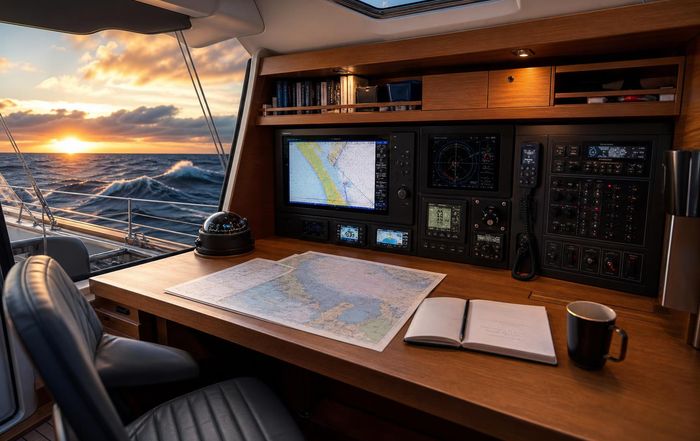
A generous, flat work surface remains essential, even in a digital age. Offshore navigators still need space to spread out a chart, annotate a weather printout or lay out a pilot book. The desk should have fiddles high enough to keep pencils, plotters and notebooks in place when the yacht is heeled or rolling, but not so high that they interfere with writing or chartwork. Many successful bluewater designs include a hinged lid or dedicated chart drawer beneath the desktop, allowing charts and documents to be stowed flat and dry while keeping them quickly accessible.
Seating deserves as much attention as electronics. A navigator who can brace comfortably against heel and motion is more likely to work accurately and remain at the station long enough to analyze complex weather data or traffic situations. Some offshore-oriented yachts provide a dedicated navigation seat with a backrest and integrated grab points, while others use a secure bench that also serves the saloon. The key is to ensure that the navigator can reach critical controls, radios and displays without stretching or twisting, which becomes particularly important in rough conditions and at night.
Good handholds are a hallmark of seamanlike design. The path between the companionway, nav station and galley is among the most traveled routes on passage, and the navigation area should be framed by solid grab rails that allow a crew member to move safely while the boat is pitching. This is an area where traditional offshore builders from northern Europe and bluewater specialists from the United Kingdom and France continue to excel, and it is frequently noted in independent reviews from sources such as Sail Magazine.
Lighting is another critical ergonomic factor. Offshore navigation stations benefit from a combination of adjustable red or dimmable white task lighting for night work, general area lighting for daytime and twilight, and, where possible, some natural light to reduce eye strain during longer stints. The ability to control screen brightness and reduce glare on displays is equally important, particularly on yachts sailing at lower latitudes where sun angles can be harsh. Many owners also specify curtains or removable covers for portholes near the nav area to protect night vision when necessary.
Finally, acoustic and thermal comfort should not be overlooked. The navigation station is often where crew monitor weather during the small hours and where skippers make critical decisions under pressure. Good ventilation, proximity to heating or air conditioning outlets and some degree of sound insulation from the engine room and machinery spaces can make a tangible difference to the navigator's effectiveness over a long offshore leg.
Integrating Modern Electronics: From Chartplotter to Command Center
The explosion of marine electronics over the past decade has transformed the offshore navigation station into a multi-layered information hub. The best designs now resemble compact command centers, integrating navigation, communication, systems monitoring and, increasingly, remote diagnostics.
At the core of most offshore nav stations is a multi-function display (MFD) or networked chartplotter from manufacturers such as Garmin, Raymarine, B&G or Simrad, typically mounted at eye level for seated viewing. These systems aggregate GPS data, electronic charts, AIS targets, radar overlays and often depth and wind information into a single interface. Many long-range cruisers also specify a second MFD at the helm, ensuring that primary navigation data is available both in the cockpit and at the nav station, with full redundancy in case of a display or network failure.
Radar remains a vital tool for offshore safety, particularly in areas with heavy shipping, fishing fleets or low visibility. Modern solid-state radar systems, such as those using Doppler technology, provide clearer target discrimination and lower power consumption than earlier magnetron units, making them well suited to bluewater yachts with finite energy budgets. Offshore navigators often prefer to have radar controls and display within reach at the nav station, where they can interpret targets in a calmer environment than the cockpit, especially during night watches or in poor weather. More detailed explanations of radar use in collision avoidance and weather detection can be found in training resources provided by organizations like the United States Coast Guard and US Power Squadrons, accessible through sites such as uscgboating.org.
AIS (Automatic Identification System) integration has become almost universal on serious offshore yachts. A full transceiver allows the vessel not only to see nearby commercial and recreational traffic but also to be seen, with dynamic information on course, speed and closest point of approach. At the navigation station, AIS data is typically overlaid on charts, and alarms are configured to warn of potential collision risks. Many bluewater crews also use AIS data in combination with satellite weather and routing tools to plan optimal approaches to busy straits, port entries or convergence zones.
Communication systems form another pillar of the modern nav station. While coastal yachts may rely primarily on VHF, offshore sailors often combine a fixed VHF with Digital Selective Calling (DSC), an HF/SSB radio for long-range voice and data communication, and one or more satellite devices such as Iridium or Inmarsat terminals. These systems support not only emergency contact but also the reception of GRIB weather files, text-based forecasts and email. Organizations such as NOAA and Météo-France provide extensive marine weather resources that can be downloaded or accessed via satellite, and further detail on these services is available through portals like weather.gov/marine.
Increasingly, the nav station is also where onboard network infrastructure is centralized. Routers, Wi-Fi access points, NMEA gateways and sometimes 4G/5G modems or Starlink terminals are installed in this area, with cabling and power distribution carefully organized. This enables integration between traditional marine instruments, tablets, laptops and cloud-based services, turning the navigation station into a digital bridge between the yacht and the wider world. For owners and project managers considering such integrations, resources on marine networking and cybersecurity from technology-focused bodies such as the National Institute of Standards and Technology (NIST) and specialist marine IT consultancies can be invaluable, and broader technology trends relevant to yachting are regularly explored in our own technology coverage.
Storage, Power Management and Systems Access
Beyond screens and instruments, the functionality of an offshore navigation station depends heavily on what is behind and beneath the visible surfaces. Thoughtful storage, power management and systems access are often what distinguish a merely adequate nav area from an exceptional one.
Storage at the nav station must accommodate not only charts and pilot books but also logbooks, manuals, spare fuses, connectors, handheld GPS units, emergency beacons, headlamps and small tools. Well-designed stations feature a combination of drawers, shelves with fiddles and dedicated pockets or brackets for essential items that must be immediately accessible in an emergency. Offshore sailors often develop personalized layouts, but the underlying design should support clear organization and secure stowage.
Power management is especially critical offshore, where energy budgets are finite and reliability is paramount. The navigation station is typically the location of the DC distribution panel, AC breakers and monitoring systems for batteries, solar arrays, wind generators and alternators. Modern cruisers frequently install battery monitoring systems that display state of charge, current draw and historical usage patterns, allowing the navigator or skipper to balance power-hungry systems such as radar, refrigeration and autopilots against available generation. Guidance on best practices in marine electrical design and safety is available from organizations like the American Boat and Yacht Council (ABYC) and International Organization for Standardization (ISO), and these standards increasingly influence how reputable yards and refit yards configure their electrical panels and wiring.
Access to wiring, plumbing runs and behind-panel spaces is another hallmark of a serious offshore nav station. In the event of a fault or emergency, the ability to quickly trace and isolate a problem can make the difference between a minor inconvenience and a major systems failure. Many bluewater-oriented yachts incorporate removable panels, labeled wiring looms and clearly marked bus bars around the nav area, recognizing that the station is effectively the nerve center of the vessel. Owners considering refits or new builds can gain further insight into such details by examining high-quality installations during boat shows and by consulting specialist marine electricians, a topic we regularly touch on in our boats and systems features.
Cockpit vs. Interior: Dual-Station Navigation for Bluewater Cruising
As electronics have become more robust and weather-resistant, many cruising yachts have adopted dual navigation stations, with a primary or secondary MFD and instruments mounted at the helm or under the companionway sprayhood. This evolution has prompted an ongoing discussion in the offshore community about the relative roles of cockpit and interior navigation spaces.
For bluewater sailors, cockpit-based instruments offer undeniable advantages in terms of situational awareness. A helmsman can see wind shifts, depth changes, AIS targets and course information without leaving the wheel, which is particularly valuable when short-handed or sailing in challenging conditions. Modern sailing instruments from brands like B&G and Raymarine are designed to be legible in bright sunlight and at night, and many systems allow key data to be repeated on wireless displays or smartwatches.
However, offshore experience suggests that a fully equipped interior nav station remains essential. In heavy weather, at night or in cold and wet conditions, the ability to navigate, plan routes and manage communications from a dry, stable environment significantly reduces fatigue and error rates. On long passages, watchkeepers often rotate between cockpit and nav station duties, with the interior station serving as a place to analyze new weather data, update logs and make strategic decisions without the distractions and physical demands of being on deck.
The most effective offshore setups therefore treat the cockpit and interior nav station as complementary rather than competing spaces. Primary controls for autopilot, engine and emergency stop systems are typically accessible from the cockpit, while the interior station houses the main planning tools, communications and systems monitoring. Data is shared over a robust network, with clear priorities assigned to alarms and alerts to avoid confusion. This integrated approach reflects the broader shift toward systems thinking in yacht design, an evolution that is mirrored in our cruising-oriented coverage and in the practices of experienced ocean sailors across the world.
Safety, Training and Human Factors
A well-designed navigation station is only as effective as the crew who use it. Offshore safety organizations and training bodies consistently emphasize that equipment must be paired with skills, procedures and human-centered thinking.
Training in traditional and electronic navigation remains a cornerstone of offshore preparation. Courses offered by bodies such as the RYA, US Sailing and International Sailing Federation (World Sailing) cover not only chartwork and GPS use but also radar interpretation, AIS collision avoidance, GMDSS procedures and emergency communication protocols. These skills are directly exercised at the nav station, and many training yachts are explicitly configured to reflect offshore best practice in their navigation layouts. Prospective bluewater cruisers can explore structured training pathways through resources such as ussailing.org and worldsailing.sport.
Standard operating procedures for the navigation station are another key element of safety. Offshore crews benefit from clear policies on logbook entries, position reporting intervals, watch handovers and the handling of alarms. Many experienced skippers require that certain decisions, such as course alterations in traffic separation schemes or responses to collision alarms, be documented and, where possible, discussed at the nav station before being executed on deck. This disciplined approach reduces the risk of miscommunication and ensures that the nav station functions as a shared reference point rather than a personal workspace.
Human factors research, including studies by maritime safety agencies and academic institutions, highlights the importance of workload management and fatigue mitigation in navigation tasks. Complex interfaces, poorly organized displays or noisy, uncomfortable nav stations can exacerbate cognitive load and increase the likelihood of error, particularly during night watches or in deteriorating weather. By contrast, clear labeling, intuitive layouts and comfortable seating can help maintain performance over extended periods. Those interested in the broader context of human factors in maritime operations can explore resources from organizations such as the International Maritime Organization (IMO) and specialist institutes like the Maritime Research Institute Netherlands (MARIN), which regularly publish findings relevant to both commercial and recreational vessels.
Sustainability and Future Directions in Offshore Navigation Spaces
As the yachting sector increasingly engages with environmental responsibility and sustainable innovation, the design and operation of navigation stations are also evolving in ways that support lower-impact cruising.
Energy efficiency is one of the most immediate concerns. Offshore nav stations now often incorporate low-power electronics, LED lighting and carefully planned power distribution to reduce overall consumption. This aligns with the growing use of renewable generation on yachts, including solar panels, hydrogenerators and high-efficiency alternators, enabling extended passages with minimal reliance on fossil fuels. Owners seeking to optimize their yachts for more sustainable long-range cruising can find practical guidance and case studies in specialist resources on green boating and in our own sustainability features.
Digitalization also offers opportunities to reduce paper usage, with many yachts transitioning to primarily electronic charts and digital pilotage resources. Nevertheless, most offshore experts still advise maintaining a core set of paper charts and printed reference materials as a backup. The balance between digital convenience and traditional resilience is likely to remain a defining characteristic of offshore navigation stations for years to come.
Looking ahead, advances in connectivity and data analytics are poised to further transform the nav station into a sophisticated decision-support environment. Cloud-synchronized logbooks, AI-assisted routing tools and integrated performance analytics are already emerging on the market, with some systems drawing on big data from commercial shipping and racing fleets to refine recommendations. At the same time, concerns about data security, system complexity and over-reliance on automation are prompting a renewed emphasis on fundamental seamanship skills and robust backup systems.
For Yacht Review which follows these developments across its global yachting coverage and business analysis, the most inspiring aspect of this evolution is the way it blends tradition and innovation. The best offshore navigation stations of today still honor the seaman at the chart table, pencil in hand, while equipping that navigator with tools and information that previous generations could scarcely imagine.
Bringing It All Together: The Offshore Nav Station as Strategic Asset
For owners, captains and project teams planning serious offshore sailing, the navigation station should be treated not as an afterthought but as a strategic asset that underpins safety, performance and onboard life. A well-conceived nav station supports clear thinking in difficult moments, enables efficient watchkeeping, fosters good communication within the crew and integrates the yacht into global networks of weather, routing and safety information.
In practical terms, this means prioritizing secure and comfortable seating, ample and organized work surfaces, thoughtful lighting, robust and redundant electronics, disciplined power management, excellent systems access and a layout that supports both focused work and easy interaction with the rest of the vessel. It also means investing in training and procedures that ensure the station is used to its full potential, rather than being reduced to a collection of underutilized screens and switches.
For sea loving individuals, whether planning an Atlantic crossing, a high-latitude expedition or a long-term circumnavigation, the navigation station is not merely a technical space but a reflection of the yacht's overall philosophy. A boat that takes its nav station seriously is usually one that has been thought through in other critical areas as well, from seaworthiness and systems engineering to interior ergonomics and long-term livability. Those exploring new builds or refits can find further inspiration and real-world examples across our news and project coverage, as well as in our broader perspectives on yachting lifestyle and travel.
Ultimately, the best navigation stations for offshore sailing are those that give their crews confidence: confidence that they understand where they are, where they are going and what lies ahead; confidence that they can communicate and coordinate when it matters most; and confidence that, even far from land, they are supported by a well-designed, well-equipped and well-managed heart to their vessel.