

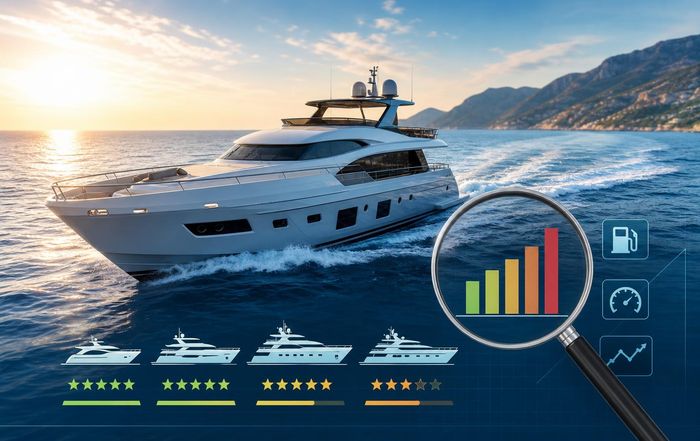
How to Compare Yacht Fuel Efficiency
Why Fuel Efficiency Matters More Than Ever
Across the global yachting community, fuel efficiency has shifted from a technical afterthought to a central measure of good seamanship, smart ownership and responsible luxury. Rising fuel prices, tightening environmental regulations and growing awareness of climate impact mean that yacht owners, charterers and builders are now examining every litre burned with far more scrutiny than even a decade ago.
This trend is not only about cost control; it is about understanding how design, technology and operational practice combine to deliver quieter, cleaner and more enjoyable time on the water. Comparing yacht fuel efficiency is, however, more complex than comparing cars or aircraft, because yachts operate in highly variable conditions and are often used in very different ways, from high-speed weekend hops to long-range bluewater cruising.
This well thought out article explores how serious buyers and experienced owners can make meaningful comparisons, which technical and operational factors truly matter, and how the industry is innovating to deliver better performance with a smaller environmental footprint.
Defining Fuel Efficiency in a Marine Context
When professionals discuss yacht fuel efficiency, they rarely stop at a simple "litres per hour" figure. That number, read in isolation, can be misleading, because it does not account for the yacht's size, speed, range or payload. Instead, naval architects, surveyors and informed buyers look at fuel use in relation to the work being done or the distance being covered.
The most common practical measure is fuel consumption per nautical mile at a given speed. This allows meaningful comparison between yachts of different sizes and engine powers, provided the speeds and conditions are clearly stated. A displacement cruiser that burns 15 litres per hour at 8 knots may appear more economical than a planing yacht consuming 200 litres per hour at 22 knots, yet on a per-mile basis the picture can be very different.
Professionals also consider specific fuel consumption, expressed in grams of fuel per kilowatt-hour, when comparing engine technologies or propulsion systems. While this is more technical, it helps explain why some engines or hybrid systems deliver superior efficiency at certain loads. Publicly available engine data from manufacturers such as MAN Energy Solutions, Caterpillar Marine and Volvo Penta provide useful reference points, although actual in-service performance depends heavily on hull design and real-world loading.
For a broader understanding of marine energy use and emissions, resources from the International Maritime Organization on greenhouse gas reduction in shipping help place yacht fuel efficiency into the wider regulatory and environmental context.
Key Design Factors That Drive Fuel Efficiency
The foundation of any fuel-efficient yacht is its naval architecture. Hull form, displacement, beam, propulsion configuration and materials all exert strong influence on how much power is required to move the vessel through the water at a given speed.
Displacement and semi-displacement hulls are generally more efficient at moderate speeds, especially for long-range cruising, because they are designed to push through the water rather than ride on top of it. Planing hulls, by contrast, are optimised for higher speeds but usually require significantly more power and fuel once on the plane. This is why serious passagemaking yachts, such as ocean-capable trawlers and explorer vessels, tend to favour displacement or semi-displacement forms, often with fine entries and fuller stern sections to reduce drag and improve tracking.
Beam and underwater shape also matter. A wider beam can increase interior volume and stability at rest, but it often increases wetted surface area and drag. Advanced hull forms, including wave-piercing bows, vertical stems and carefully optimised chines, have been adopted by many leading builders to improve efficiency without sacrificing comfort. People interested in how these design choices translate into real-world performance can explore detailed project discussions in our own yacht design features.
Materials have a secondary but still important role. Lightweight composite construction, aluminium superstructures on steel hulls and careful weight distribution reduce the power required to reach and maintain cruising speed. However, weight savings must be balanced against durability, cost and comfort, especially on larger superyachts where sound insulation and structural stiffness are non-negotiable.
Finally, appendages such as stabiliser fins, shafts, skegs and rudders can add drag if not optimally designed. Recent developments in retractable stabilisers, optimised shaft lines and low-drag rudders show how incremental refinements across the underwater profile can produce measurable gains in fuel efficiency over the life of the yacht.
Propulsion Systems and Their Impact on Consumption
Comparing fuel efficiency across yachts is impossible without understanding the propulsion systems involved. Traditional shaft drives remain common, particularly on larger displacement vessels, but pod drives, waterjets, hybrid systems and, increasingly, alternative fuels all influence consumption patterns.
Pod propulsion systems such as Volvo Penta IPS and Cummins Zeus have been widely reported to offer improved fuel efficiency and manoeuvrability for many planing and semi-displacement yachts in the 40-80 foot range. By combining forward-facing propellers with steerable pods and integrated exhausts, these systems can reduce drag and optimise thrust direction, often resulting in lower fuel burn at typical cruising speeds compared with conventional shaft drives. Independent tests published in leading boating media and data shared by manufacturers suggest efficiency gains in many installations, although the actual benefit depends heavily on hull design and loading.
Waterjets are favoured for high-speed applications and shallow-water operations, providing excellent manoeuvrability and reduced underwater appendage drag, but they may not match the fuel efficiency of optimised shaft or pod systems at moderate cruising speeds. Owners focused primarily on long-range cruising rather than top speed often prefer more conventional propulsion for this reason.
Hybrid and diesel-electric systems have gained momentum in the superyacht segment and are increasingly visible in smaller yachts as well. These configurations combine internal combustion engines, electric motors and battery banks to allow flexible operating modes, such as electric-only manoeuvring in harbour, diesel-electric cruising at optimised engine loads, or hotel load support from batteries at anchor. While the complexity and upfront cost are higher, the potential for reduced fuel consumption, lower noise and lower emissions is significant when systems are correctly engineered and used in appropriate profiles. Technical overviews from organisations such as DNV and Lloyd's Register on alternative propulsion and energy efficiency provide a useful framework for understanding these developments.
When comparing yachts, it is therefore essential to consider not only the rated engine power, but also the type of propulsion, the presence of hybrid components, and how these systems are integrated into the overall design.
Speed, Range and the Fuel Efficiency Trade-Off
Fuel efficiency cannot be assessed without acknowledging the fundamental trade-off between speed and consumption. Power demand increases disproportionately with speed, especially as a yacht approaches or exceeds its hull speed or transitions into planing mode. This means that modest reductions in cruising speed often produce substantial fuel savings and extended range.
For displacement and semi-displacement yachts, naval architects often specify an "economical cruising speed" at which the hull moves efficiently with minimal wave-making resistance. Operating significantly above this speed band can quickly erode range and increase fuel costs. For planing yachts, there is usually a lower-speed range where the hull is inefficiently dragging through the water, followed by a more efficient band once fully on the plane, and then a steep increase in consumption as speeds approach maximum.
When comparing yachts, experienced buyers therefore look at fuel consumption curves across a range of speeds rather than a single data point. Builders who provide transparent fuel burn graphs and range estimates based on tank capacity and real-world sea trials enable more accurate comparisons. Analytical tools and calculators from organisations such as American Boat and Yacht Council (ABYC) and technical articles in publications like Professional BoatBuilder can help owners interpret these curves and understand where each yacht performs best.
Our boat reviews place particular emphasis on real-world cruising profiles, highlighting how a yacht behaves at different speeds, what range can be realistically expected, and how that aligns with the intended use, whether coastal weekending, Mediterranean passages or transoceanic voyages.
Operational Practices: The Human Factor in Fuel Efficiency
Even the most efficient hull and propulsion package can deliver disappointing results if operated poorly. Conversely, thoughtful seamanship and smart onboard management can significantly improve fuel economy without any structural modifications.
Trim and weight distribution are among the most overlooked yet powerful levers. Excessive stern squat, bow-up attitude or uneven loading can increase drag and force engines to work harder. Many modern yachts are equipped with trim tabs or interceptors, and when properly adjusted they can reduce fuel burn at cruising speed. Owners and captains who invest time in sea trials under varying loads, carefully noting speed, fuel consumption and trim settings, often discover "sweet spots" that deliver smoother rides and meaningful savings.
Propeller condition is another critical variable. Fouled hulls and propellers, bent blades or mismatched pitch can significantly increase resistance and reduce efficiency. Regular hull cleaning and propeller maintenance, guided by manufacturer recommendations and classification society rules, are therefore essential. Studies cited by organisations such as the International Council on Clean Transportation, accessible through their marine efficiency research, show that biofouling can have a substantial impact on fuel use for commercial vessels, and the same principles apply to yachts, even if on a smaller scale.
Route planning and weather routing also contribute directly to fuel efficiency. Choosing favourable currents, avoiding unnecessary detours and timing passages to minimise head seas and strong winds can reduce engine load and improve comfort. Increasingly, captains use advanced routing software and real-time weather data, similar to systems used in commercial shipping and offshore racing, to optimise passages for both time and fuel.
For sailors interested in real-world cruising strategies, the practical experiences shared in our cruising features often highlight how thoughtful planning and conservative operation can transform both the efficiency and enjoyment of long passages.
How to Interpret Builder Data and Independent Tests
Comparing yacht fuel efficiency inevitably involves interpreting data from different sources, each with its own assumptions and limitations. Builders typically publish performance figures based on factory sea trials, often conducted in light load conditions, with clean hulls and ideal trim. While these numbers are useful for relative comparison within a builder's range, they may not fully reflect real-world usage, especially once cruising stores, tenders, water toys and personal effects are aboard.
Independent sea trials conducted by reputable magazines and testing organisations provide an important counterbalance, as they often test yachts closer to realistic load conditions and describe sea state, wind and other variables. When reviewing such tests, readers should pay close attention to the stated displacement during trials, the fuel and water levels, and any additional equipment installed. Comparing like-for-like requires aligning these conditions as closely as possible.
Where discrepancies appear between builder data and independent reports, the underlying reasons are often practical rather than deceptive: different loadings, varying sea states, or changes in engine tuning or propeller specification between early and later hulls. Nonetheless, a pattern of significant divergence should prompt further questions and, ideally, a personal sea trial.
Our editorial approach at yacht-review.com is to contextualise any performance figures within the broader design and usage profile of the yacht, and to cross-reference data where possible. Readers can explore examples of this methodology in our boat and yacht overviews, where we emphasise transparency and practical guidance over headline numbers.
Emerging Technologies and Alternative Fuels
The drive for improved fuel efficiency is increasingly intertwined with the broader decarbonisation of maritime transport. While yachts represent a small fraction of global shipping emissions, the sector is under growing scrutiny, and many owners are personally motivated to reduce their environmental footprint without compromising comfort or capability.
Advances in battery technology have enabled more capable hybrid systems, allowing longer periods of silent running and greater flexibility in energy management. Some new builds and refits now incorporate substantial battery banks paired with solar arrays and advanced energy management systems, enabling low-load hotel functions to be powered without running generators for extended periods. This does not eliminate fuel consumption but can significantly reduce it, especially for yachts that spend considerable time at anchor.
Alternative fuels such as hydrotreated vegetable oil (HVO), methanol and, in experimental cases, hydrogen, are being explored by forward-looking builders and classification societies. Reports from organisations like the Royal Institution of Naval Architects and technical briefings from Bureau Veritas on low-carbon marine fuels highlight both the potential and the challenges, including fuel availability, storage requirements, safety considerations and lifecycle emissions. For most yacht owners in the near term, these fuels will complement, rather than replace, traditional marine diesel, but they represent an important pathway to lower emissions per mile.
At Yacht Review, we follow these changes closely in our technology coverage and in our dedicated sustainability features, focusing on practical innovations that owners can adopt today as well as visionary concepts that signal where the industry is heading.
Practical Steps for Owners Comparing Fuel Efficiency
For owners or prospective buyers seeking to compare yacht fuel efficiency in a disciplined, businesslike manner, a structured approach is essential. The starting point is to define the primary usage profile: coastal day trips, seasonal Mediterranean or Caribbean cruising, long-range exploration, or a mix of charter and private use. Each profile places different emphasis on speed, range, payload and hotel load, and therefore changes which efficiency metrics matter most.
The next step is to assemble comparable data for shortlisted yachts. This includes displacement, hull type, engine and propulsion configuration, tank capacities, and published fuel consumption at multiple speeds. Where possible, independent test data and owner reports should be consulted, with particular attention to conditions and load. For high-value decisions, commissioning a custom sea trial with fuel flow meters and GPS logging can provide the most reliable basis for comparison.
Owners should also factor in the potential for efficiency improvements through specification choices, such as propeller optimisation, advanced antifouling systems, waste heat recovery for water heating, or upgraded energy management systems. While each measure may deliver modest gains, the cumulative effect over years of operation can be substantial, especially for yachts with intensive cruising schedules.
From a financial perspective, incorporating realistic fuel cost projections into total cost of ownership models can clarify the long-term value of a more efficient yacht, even if the purchase price is higher. Industry analyses from organisations such as Boston Consulting Group and McKinsey & Company, available through their general work on sustainable business practices, demonstrate how efficiency investments can create durable value in other transport sectors, and the same logic applies in yachting, albeit at different scales.
Our business-focused articles frequently examine these trade-offs, helping owners and family offices align yacht investments with broader financial and sustainability objectives.
The Lifestyle Dimension of Efficient Yachting
Fuel efficiency is often framed purely in technical or financial terms, but for many in the yachting community it has become part of a broader lifestyle philosophy. Cruising at slightly lower speeds, choosing more direct routes, spending longer in each anchorage and relying more on natural ventilation and passive comfort can all reduce fuel use, while often enhancing the quality of time spent aboard.
Owners who embrace this mindset often report a more relaxed style of cruising, less dominated by tight schedules and high-speed transfers between marinas. Slow travel advocates in the wider tourism sector, including respected voices featured by organisations such as National Geographic Travel, have long argued that reduced pace can deepen engagement with destinations and communities. Similar principles apply on the water, where a more measured approach can reveal subtler coastal landscapes, wildlife and cultural experiences.
For those seeking inspiration on how efficient, thoughtful cruising can enrich onboard life, our lifestyle coverage and travel features showcase owners and crews who combine technical sophistication with a strong sense of place and purpose.
Global Perspectives and Regional Considerations
Fuel efficiency priorities can vary significantly by region, influenced by fuel prices, regulatory regimes, typical cruising distances and local infrastructure. In Europe, where many popular cruising grounds are within relatively short distances but fuel costs and environmental regulations are stringent, owners may prioritise moderate-speed efficiency and advanced emissions control systems. In North America, where long coastal runs and offshore passages are common, range and sea-keeping at economical speeds are often paramount.
In regions such as Southeast Asia, the South Pacific and parts of South America and Africa, access to high-quality marine fuel and service infrastructure can be more variable, making robust, efficient systems and generous tankage especially important. Observations from global yacht management firms and technical advisors, alongside data from bodies such as the European Maritime Safety Agency and US Environmental Protection Agency, help illustrate how regional policies and market conditions shape yacht design and operation.
At yacht-review.com, our global coverage aims to bridge these perspectives, highlighting how owners in different markets address fuel efficiency within their own cruising realities, from Norwegian fjords and Mediterranean islands to Pacific archipelagos and North American coastal routes.
Efficiency as a Core Measure of Excellence!
As yacht design and technology evolve, fuel efficiency is increasingly seen not as a constraint but as a hallmark of excellence. The most admired new builds and refits often combine elegant lines, refined interiors and cutting-edge comfort systems with hulls and propulsion packages that deliver impressive range and low consumption for their size and capability.
For the community here, this convergence of performance, responsibility and enjoyment represents a powerful opportunity. Owners who invest in efficient yachts and operate them thoughtfully not only reduce operating costs and environmental impact, they also set a standard for what modern yachting can be: technically sophisticated, globally aware and deeply attuned to the sea.
Digital fans interested in following the latest shifts in efficient yacht design, propulsion and operations can stay informed through our regularly updated news section and broader site coverage, where fuel efficiency is treated as a central pillar of future-ready yachting rather than a secondary concern.