

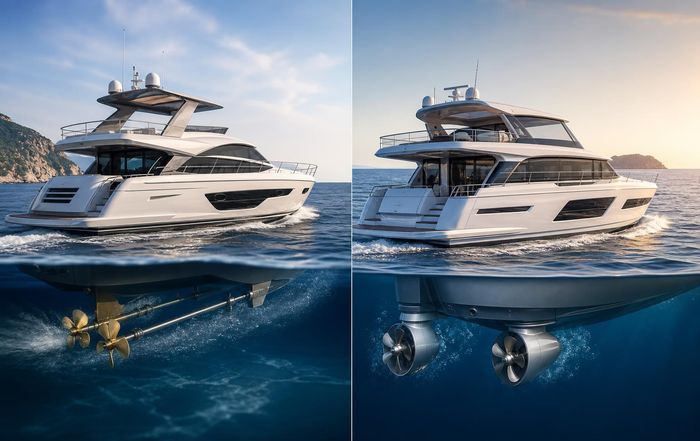
Comparing Shaft Drive and Pod Drive Motor Yachts
Motor yacht propulsion has undergone a quiet but profound transformation over the past two decades. Traditional shaft drive systems, once regarded as the default choice for everything from compact flybridge cruisers to full-displacement superyachts, now share the stage with pod drive configurations that promise enhanced maneuverability, fuel efficiency, and comfort. For owners, captains, and buyers who follow us for informed daily perspectives on boats, cruising and design, understanding the trade-offs between these systems has become essential to making confident, future-proof decisions.
This article examines shaft drive and pod drive motor yachts through the lens of real-world experience, technical development, and emerging trends in yacht ownership and operation. It considers performance, handling, efficiency, maintenance, resale, and the broader lifestyle implications that matter to discerning yacht buyers and charter clients.
How Shaft Drives and Pod Drives Work
Traditional shaft drive systems are mechanically straightforward. The engine is mounted inside the hull and connected via a straight or slightly angled propeller shaft to a propeller and rudder assembly. The shaft passes through a stern tube with seals and bearings, while steering is achieved by turning the rudder behind the propeller. This configuration has been refined over many decades and remains the dominant solution in many commercial vessels, long-range cruisers, and larger superyachts.
Pod drive systems, by contrast, combine propulsion and steering into a single steerable unit mounted beneath the hull. In most modern motor yachts, the engine is installed inside the hull and connected to the pod via a vertical shaft or transmission, and the entire pod rotates to direct thrust. The most widely known examples include Volvo Penta's IPS (Inboard Performance System) and Cummins MerCruiser Diesel's Zeus pods, both of which integrate steerable pods with electronic controls and, in many installations, joystick maneuvering. Readers can explore the technical background of these systems through manufacturers' resources and independent coverage on platforms such as BoatTEST.com and Professional BoatBuilder.
From a design standpoint, pod systems allow naval architects to position engines further aft and lower in the hull, which can free up interior volume and improve weight distribution. Shaft drives, in contrast, demand more longitudinal space and typically require a deeper shaft angle, especially in planing yachts, which influences hull form and internal layout. This interplay between propulsion technology and overall yacht architecture is a recurring theme in contemporary yacht design and is discussed frequently in our own yacht design insights.
Performance and Efficiency at Sea
Performance and efficiency are central to any propulsion comparison, and over the past 15 years pod systems have built a strong reputation in this regard, particularly in the 40- to 80-foot market segment. Independent sea trials published by sources such as Motor Boat & Yachting and Yachting Magazine have repeatedly documented that pod-equipped motor yachts often achieve higher cruising speeds and lower fuel consumption than comparable shaft-driven models at similar displacement and power levels, especially in planing and semi-planing hulls.
The efficiency advantage is largely due to the hydrodynamic characteristics of pods. Because the pod unit operates in relatively undisturbed water and directs thrust more horizontally, there is less energy lost to hull resistance and propeller shaft angle. Furthermore, the counter-rotating propellers used on many pod systems improve thrust and reduce cavitation, which can translate into better acceleration and more economical cruising. Readers interested in the technical underpinnings of marine propulsion efficiency can find further background through resources from The Royal Institution of Naval Architects and technical articles on Marine Technology News.
Shaft drive systems, however, retain advantages in specific contexts. On heavy displacement or long-range expedition yachts, where hull speed rather than planing performance governs cruising behavior, the theoretical efficiency gains from pods are often less pronounced. Many long-range builders and designers, particularly in the 80-foot-plus segment, continue to favor shaft drives for their robustness, simplicity, and predictable behavior in heavy seas. For these vessels, fuel efficiency is achieved primarily through hull design, engine selection, and careful load management, areas that are frequently explored in our cruising features.
Ultimately, the performance comparison is not one-size-fits-all. Pod drives tend to shine in mid-size planing motor yachts where speed, maneuverability, and fuel economy are all priorities, while shaft drives remain highly competitive in larger or more traditional cruising designs focused on range, redundancy, and straightforward engineering.
Maneuverability and Handling
One of the most visible differences between pod and shaft drive yachts is in close-quarters handling. Pod systems, with their steerable drives and integrated electronic controls, have redefined what is possible when docking in tight marinas or maneuvering in crowded harbors. Joystick control, now widely available on pod-equipped yachts, allows the skipper to move the vessel laterally, pivot within its own length, or execute complex maneuvers with a single control, a feature that has lowered the perceived barrier to entry for new owners and charter guests.
This ease of handling has been widely documented in sea trial reports and owner feedback across leading yachting publications and forums, including Boat International, Yachting, and Power & Motoryacht. The ability to integrate pods with bow and stern thrusters, dynamic positioning systems, and advanced autopilots further enhances this capability and aligns closely with the growing trend toward assisted and semi-autonomous vessel control. Those interested in broader developments in marine autonomy and control systems can explore research and industry coverage on sites such as DNV and Lloyd's Register.
Traditional shaft drive yachts can also be highly maneuverable, particularly when equipped with powerful bow and stern thrusters and modern electronic engine controls, but they typically require more seamanship and practice to handle with the same precision in confined spaces. Throttle and gear changes must be coordinated with rudder input, and the behavior of the vessel in reverse or with wind and current on the beam can be more nuanced. Many experienced captains value this direct, mechanical feel and the predictability of a well-designed shaft system, but for owner-operators stepping up from smaller boats or considering their first serious motor yacht, the intuitive handling of pods is often a compelling factor.
At sea, both systems can deliver excellent handling characteristics when matched to an appropriate hull. Pods contribute to precise course-keeping and responsive turning, while shafts, particularly with twin rudders and optimized running gear, provide a solid and reassuring feel in varying sea states. The choice often comes down to the owner's priorities and the intended cruising grounds, subjects that are central to our boat reviews and comparisons.
Comfort, Noise, and Vibration
Comfort underway is a key differentiator for many buyers, especially those planning extended cruising or hosting guests who may be new to yachting. Pod drive systems are frequently praised for reduced vibration and lower noise levels, owing to the location of the propulsion units outside the hull and the more efficient transfer of power. Many builders report that pod configurations allow engines to run at lower rpm for a given speed compared to equivalent shaft installations, which can further reduce onboard noise.
Independent test data and builder statements, reviewed across multiple publications, suggest that pod-equipped yachts often achieve noticeably lower sound levels in main salons and cabins at cruising speeds when compared with similar shaft-driven models. While the exact figures vary by builder and model, the trend is consistent enough to be considered a reliable characteristic, particularly in the 40- to 70-foot segment where engine rooms are relatively close to living spaces.
Shaft drive yachts, however, have also made significant strides in comfort through advances in engine mount technology, sound insulation, and hull design. Many premium builders invest heavily in vibration isolation, acoustic damping, and careful machinery layout to deliver quiet, refined interiors even at higher speeds. For owners considering a new build or a high-quality brokerage yacht, the difference in comfort between a well-engineered shaft drive vessel and a pod-equipped counterpart may be less about the propulsion technology itself and more about the overall design and construction philosophy of the yard.
Comfort at anchor is more a function of hull form, stabilization systems, and anchoring arrangements than propulsion type. Both shaft and pod drive yachts can be fitted with fin stabilizers, gyroscopic stabilizers, or interceptors to reduce roll and improve onboard comfort, a topic explored regularly in our coverage of yachting technology.
Maintenance, Reliability, and Service Network
Maintenance and reliability considerations often influence propulsion choices as much as performance or handling. Shaft drive systems are inherently simple, with fewer submerged moving parts and a long track record in commercial and recreational vessels. Routine maintenance includes shaft seal inspection, bearing checks, alignment, and periodic propeller and rudder work, all of which are familiar to marine engineers worldwide. In many cruising regions, especially remote or developing areas, finding technicians experienced with traditional shafts is relatively straightforward.
Pod drive systems, by contrast, incorporate more complex underwater gear, including seals, gears, and steering mechanisms contained within the pod. Regular maintenance typically involves pod inspections, seal and anode replacement, oil changes for the pod units, and attention to electronic control systems. While manufacturers such as Volvo Penta and Cummins have expanded their global service networks significantly, owners planning extensive bluewater cruising or voyages to remote areas often weigh the availability of specialized service when considering pods versus shafts. Prospective buyers can review manufacturer service coverage and maintenance schedules on official product pages and through independent guidance from organizations such as ABYC and IMCI.
Reliability data is more nuanced. Early generations of pod systems experienced some well-publicized issues related to seals and gear failures, particularly in demanding commercial applications, and these were reported and analyzed in trade publications and technical forums. Over time, manufacturers have introduced design improvements and updated maintenance protocols, and current-generation pods are generally regarded as reliable when properly installed and maintained. For shaft drives, the main reliability concerns typically involve shaft alignment, seal integrity, and potential damage from grounding or debris, all of which can be mitigated through regular inspection and prudent navigation.
Insurance and classification perspectives also play a role. Some underwriters and surveyors may apply different criteria or recommendations to pod versus shaft installations, particularly for larger yachts or vessels operating under commercial codes. Owners and captains are well advised to consult with surveyors and insurers early in the decision process, a step that aligns with best practices in yacht ownership and is regularly highlighted in our business and ownership coverage.
Design, Space Planning, and Lifestyle On Board
Beyond engineering, propulsion choices have significant implications for interior and exterior design, which in turn shape the onboard lifestyle that matters so much to Yacht-Review.com readers. Pod systems, by relocating the thrust line further aft and reducing the space required for long propeller shafts, can free up valuable interior volume for larger cabins, expanded storage, or creative layout solutions. Many contemporary flybridge and sport motor yachts have taken advantage of this flexibility to offer full-beam master suites, larger crew quarters, or improved tender garages in hull lengths where such features were once difficult to accommodate.
Shaft drive yachts, while more constrained by the need to accommodate shafts and a traditional engine room layout, often compensate with generous machinery spaces that appeal to professional crew and technically minded owners. The ability to access engines, generators, and ancillary systems in a spacious, well-organized engine room can be a decisive factor for those planning longer passages or operating with a full-time engineer.
On deck, the difference may be less obvious but still meaningful. Pod installations can allow for a slightly lower engine room height or more compact machinery footprint, which in some designs translates into lower profile superstructures or expanded aft cockpit areas. For owners prioritizing outdoor living, alfresco dining, and seamless transitions between interior and exterior spaces, these subtle design gains can enhance the overall yachting experience, themes that resonate across our lifestyle features.
Interior designers and naval architects increasingly work as integrated teams to optimize hull, propulsion, and layout together, rather than treating propulsion as a fixed constraint. This holistic approach is evident in many of the latest models from leading European and American builders, whose launches are regularly covered in our yacht news section and by international media outlets such as Boat International, Yachting World, and SuperYacht Times.
Cost, Resale, and Total Ownership Economics
The economic comparison between shaft and pod drive yachts extends beyond initial purchase price. While exact costs vary widely by builder, model, and region, pod systems typically carry a higher initial equipment and installation cost than conventional shafts, reflecting their greater mechanical complexity and integration with electronic controls. However, the potential fuel savings, especially for owners who log significant annual hours, can offset part of this premium over time.
Analyses published in industry media and by some manufacturers suggest that fuel savings in the range of 10-30 percent may be achievable in certain pod-equipped planing yachts compared with similar shaft-driven configurations, although results vary based on hull design, loading, and operating profile. For buyers evaluating total cost of ownership, it is important to consider realistic usage patterns, including typical cruising speeds, annual hours, and fuel prices in their preferred cruising regions. Independent resources such as Soundings Trade Only and IbisWorld provide broader context on marine industry economics and operating trends.
Maintenance costs can differ as well. Pods may require more specialized service and parts, particularly for underwater components and electronic controls, whereas shaft systems may be easier to service in a wider range of shipyards. Insurance premiums, warranty coverage, and potential downtime for repairs should also be factored into the calculation. For many owners, engaging an experienced surveyor or marine consultant to model total ownership costs over a five- to ten-year horizon is a prudent step and aligns with professional best practice.
Resale value is influenced by market perception, brand reputation, and regional preferences. In some markets, especially in North America and parts of Europe, pod-equipped yachts from established builders are in strong demand among owner-operators seeking ease of handling and modern technology, which can support robust resale values. In other markets or in certain size segments, conservative buyers and commercial operators may continue to favor shaft drives for their perceived simplicity and long-term durability. Tracking trends in brokerage listings and transaction data through reputable yacht brokers and platforms, as well as following our own boats and brokerage coverage, can provide valuable insight into how these dynamics are evolving.
Safety, Redundancy, and Operational Considerations
Safety and redundancy are central concerns for any serious cruising program. Shaft drive systems, with their mechanical simplicity and well-understood failure modes, are often favored by long-range cruisers and expedition yacht builders who prioritize the ability to diagnose and repair issues with relatively basic tools and skills. In the event of a grounding, for example, a shaft, propeller, or rudder can be damaged, but the engine and gearbox are typically protected inside the hull, and emergency repairs or temporary measures may be possible to restore limited propulsion.
Pod drive yachts, while designed with robust protection and often featuring breakaway or sacrificial elements to mitigate damage from impacts, may be more complex to repair in the field, especially if underwater components are compromised. That said, many pod systems are installed in twin or triple configurations, and the ability to operate on one or more remaining pods can provide a degree of redundancy. In addition, advanced electronic control systems can integrate with navigation and situational awareness tools, such as radar, AIS, and forward-looking sonar, to enhance operational safety in congested or challenging waters, a direction that aligns with broader trends in maritime safety documented by organizations such as the IMO and US Coast Guard, whose resources are available via USCG Boating Safety.
For both shaft and pod drive yachts, safety ultimately depends on design quality, proper installation, diligent maintenance, and competent seamanship. Regular training, drills, and systems familiarization for owners and crew remain essential, regardless of propulsion type. Many of these best practices are discussed in our cruising and travel coverage, where real-world experiences from different cruising regions highlight the importance of preparation and prudence.
Sustainability and Environmental Considerations
Sustainability has become an increasingly important consideration in yacht design and operation. While neither shaft nor pod drives are inherently "green" in isolation, pod systems can contribute to reduced fuel consumption and emissions, particularly in planing motor yachts that spend much of their time at moderate to high cruising speeds. Lower fuel burn translates directly into lower CO₂ and pollutant emissions, aligning with broader industry efforts to improve environmental performance and comply with evolving regulations.
Organizations such as the International Council on Clean Transportation and classification societies including DNV and Bureau Veritas have published research and guidelines on marine energy efficiency and emissions reduction, and many of the principles they outline-optimized hull design, efficient propulsion, and intelligent control systems-are reflected in modern pod-equipped yacht designs. Interested readers can learn more about sustainable business practices through global initiatives led by bodies such as the United Nations Environment Programme, and can explore how these ideas intersect with yachting in our dedicated sustainability section.
Shaft drive yachts are also evolving in response to environmental pressures. Hybrid propulsion systems, alternative fuels, and advanced hull coatings can all be integrated with traditional shafts, and several leading builders have launched or announced models that combine shaft drives with battery-assisted propulsion or optimized low-emission engines. In many cases, the choice between shafts and pods is only one element in a broader sustainability strategy that encompasses design, operation, and lifecycle management.
Choosing Between Shaft and Pod Drive: Matching Technology to Mission
For beach lovers here, the decision between shaft and pod drive motor yachts often comes down to how, where, and with whom they plan to use their vessel. Owner-operators who value intuitive handling, frequent marina visits, and modern integrated controls may find pod-equipped yachts particularly attractive, especially in the 40- to 80-foot range where the benefits in maneuverability and interior volume are most pronounced. For families and friends seeking relaxed coastal cruising, weekend getaways, and easy docking, the lifestyle advantages of pods can be compelling, and many such experiences are reflected in our community features.
By contrast, owners planning extended bluewater passages, high-latitude expeditions, or operations in regions with limited technical infrastructure may gravitate toward shaft drives for their simplicity, serviceability, and long track record. Professional crew, particularly engineers with commercial backgrounds, often express a preference for the familiarity and accessibility of shaft systems, especially on larger yachts where machinery spaces can be optimized for maintenance and redundancy.
In practice, many of the world's leading builders offer both shaft and pod drive options across their ranges, tailoring propulsion choices to hull form, size, and intended market. This diversity reflects the reality that there is no universally "best" solution, only the solution that best aligns with an owner's priorities, cruising plans, and appetite for technology. As new propulsion concepts emerge, including advanced hybrid systems, electric pods, and alternative fuel engines, the conversation will continue to evolve, and we will remain committed to providing informed, balanced coverage that emphasizes experience, expertise, and trust.
Readers interested in following future developments in propulsion, yacht design, and global cruising trends can explore our broader coverage across global yachting perspectives, yachting history and heritage, and our regularly updated site. In a market where innovation and tradition coexist, understanding the strengths and limitations of both shaft and pod drive motor yachts is an essential step toward choosing the vessel that will best support the journeys, experiences, and memories yet to come.