

How to Compare Motor Yachts Before a Sea Trial
Evaluating motor yachts has become increasingly sophisticated as buyers approach each acquisition as a major capital decision rather than an impulsive lifestyle purchase. Before a sea trial is even scheduled, experienced owners, family offices and professional captains now invest significant time comparing candidate yachts on paper and in person, using a structured process that blends technical scrutiny, financial discipline and an appreciation for long-term enjoyment on the water. For the yacht-review.com audience, this pre-sea trial phase is where serious value is created, because it narrows the field to those yachts most likely to perform, hold value and deliver the intended cruising lifestyle. Take a seat as we consider how discerning buyers can compare motor yachts methodically before stepping aboard for a sea trial, drawing on current industry practice, recent market developments and the combined insights of builders, surveyors, brokers and experienced owners.
Clarifying the Mission Before Comparing Yachts
Any meaningful comparison begins with a clear definition of purpose. A 30-metre planing yacht designed for weekend coastal runs bears little resemblance in use and cost to a 30-metre steel explorer conceived for transoceanic passages, and yet both may appear side by side in a broker's portfolio. Before comparing specifications, the prospective owner, family members and professional advisors benefit from aligning around how the yacht will be used over the first five to ten years.
In practice, this means distinguishing between primarily day-boat usage, short-range coastal cruising, seasonal Mediterranean or Caribbean campaigns, or genuine bluewater voyaging. It also involves agreeing on whether the yacht will be privately used, placed into charter, or structured as a hybrid of both. Guidance from organizations such as MYBA - The Worldwide Yachting Association can help prospective charter-focused owners understand what layouts, crew arrangements and safety standards are expected in the professional charter market, which in turn influences which yachts should make the shortlist.
At yacht-review.com, discussions with buyers frequently reveal that clarifying this mission early prevents costly missteps later. A yacht that appears attractive on design alone may prove unsuitable when the family's preferred cruising grounds, seasonal plans and appetite for crew intensity are examined in detail. Readers exploring different usage profiles can find complementary insights in our dedicated sections on cruising and travel, where real-world itineraries and case studies bring these mission profiles to life.
Establishing a Comparable Shortlist
Once the intended mission is understood, the next step is to create a shortlist of yachts that are genuinely comparable. This is where many first-time buyers struggle, as brokerage listings often emphasize headline length and interior imagery while obscuring critical differences in hull form, displacement, propulsion and regulatory status.
Working with an experienced broker who is a member of a recognized professional body such as YBAA in North America or ABYA in the United Kingdom can help ensure that the shortlist is coherent and that data is verified. Market intelligence platforms such as Boat International and SuperYacht Times provide additional context on asking prices, build histories and refit activity, which assists in identifying which yachts are sensibly priced and which may carry hidden future costs.
For the yacht-review.com community, it is often useful to begin with a broader scan of the segment through curated boat reviews, then narrow the field based on displacement category, cruising speed, fuel capacity, build material and year of construction. The aim is not to compare every yacht on the market, but to select a manageable group of two to five candidates that share enough in common for meaningful side-by-side evaluation.
Understanding Hull Design, Range and Seakeeping
Before a sea trial, much of the yacht's expected behaviour can be inferred from its design and engineering. Naval architecture has advanced significantly in recent decades, and buyers now have access to more transparent information about hull forms, stability and fuel efficiency than ever before.
The first consideration is hull type: fully planing, semi-displacement, displacement or fast-displacement. Planing hulls, common among sportier motor yachts from builders such as Sunseeker and Princess Yachts, offer higher top speeds but typically at the cost of range and fuel consumption. Semi-displacement and full-displacement hulls, favoured by long-range builders such as Nordhavn and Fleming Yachts, trade outright speed for comfort, efficiency and extended cruising autonomy. Fast-displacement designs, which have been extensively documented by Marin and other hydrodynamic research institutes, attempt to blend efficiency and speed through carefully optimised hull forms.
Prospective buyers can compare range and fuel burn figures published by reputable builders and confirmed through independent testing by magazines such as Yachting Magazine and BoatTEST.com. While exact performance will vary with loading and sea state, these benchmarks allow a rational comparison of how far each yacht can cruise at a preferred speed without refuelling. For owners contemplating remote cruising, this pre-sea trial analysis is essential; it reveals which yachts are inherently suited to the mission and which would be operating at the edge of their capabilities.
Readers interested in the design implications of hull choice, including noise and vibration control, can explore our design-focused coverage, which often delves into the naval architecture behind new launches and refits.
Powertrain, Fuel Type and Emerging Technologies
The choice of engines and propulsion systems is a core differentiator between motor yachts, and this can be evaluated in detail before any sea trial. Most yachts in the 15-40 metre range rely on high-speed diesel engines from manufacturers such as Caterpillar, MTU, MAN and Volvo Penta, whose performance and maintenance characteristics are well documented. For larger yachts and explorer vessels, medium-speed engines and hybrid configurations are increasingly prevalent.
Prospective buyers are paying growing attention to fuel type and emissions, especially as ports in Europe and North America adopt more stringent environmental regulations. Although marine diesel remains the dominant fuel, there is rising interest in alternative solutions including diesel-electric hybrid systems, battery-assisted hotel loads and, in experimental cases, methanol-ready engines. Reports from DNV and the International Maritime Organization (IMO) provide up-to-date overviews of regulatory trends and technology readiness, which can inform a buyer's view of how future-proof a given propulsion package might be.
For the yacht-review.com audience, it is particularly relevant to examine whether a yacht has shaft drives, pod drives, waterjets or azimuthing thrusters, as each has implications for manoeuvrability, draft, efficiency and maintenance. Comparing yachts with similar missions but different propulsion architectures can reveal trade-offs that may not be obvious from a brochure. Our technology section regularly covers such developments, helping readers understand what is proven in service and what remains emerging.
Layout, Volume and Liveability
While engineering determines whether a yacht can safely and efficiently reach its destination, the interior layout and use of volume determine whether guests will enjoy the journey. Comparing motor yachts before a sea trial involves a careful review of general arrangement plans, interior photographs and, whenever possible, in-person visits at dock or during boat shows.
Gross tonnage, often misunderstood by new buyers, is a key metric of interior volume and should be compared alongside length overall. Two yachts of similar length can feel vastly different if one has significantly greater gross tonnage and a beamier hull. Layout considerations include the number and location of guest cabins, whether the owner's suite is on the main deck, the separation between guest and crew circulation, and the flexibility of spaces for different modes of use, from family cruising to corporate entertaining.
Leading design studios and shipyards such as Feadship, Benetti and Sanlorenzo frequently publish case studies of recent projects, illustrating how volume can be optimized through careful planning of staircases, technical spaces and glazing. Reviewing such material, together with independent evaluations on yacht lifestyle, enables buyers to benchmark how efficiently each candidate yacht uses its available volume and whether the layout aligns with the intended usage profile.
Build Quality, Classification and Regulatory Compliance
Beyond aesthetics and comfort, the build quality and regulatory status of a motor yacht have a direct impact on safety, insurability, resale value and operating flexibility. Before a sea trial, it is essential to verify under which flag the yacht is registered, whether it is built to or maintained in class with a recognised classification society such as Lloyd's Register, Bureau Veritas or RINA, and whether it complies with relevant codes such as the MCA LY3 for large commercial yachts.
Classification and compliance information can usually be confirmed through the class society's own records or through documentation provided by the broker and owner. Differences in class notation and survey status between candidate yachts can have substantial cost implications, as bringing a non-classed or out-of-class yacht up to the same standard as a recently surveyed vessel may involve extensive technical work. Guidance from organisations such as The International Council of Marine Industry Associations (ICOMIA) helps contextualise these regulatory frameworks for buyers comparing yachts across regions.
For readers of yacht-review.com, this is where professional expertise becomes invaluable. Pre-sea trial comparisons should include a review by an independent surveyor, particularly for pre-owned yachts, to flag any known structural issues, corrosion risks or compliance gaps. Our business coverage often highlights how such technical due diligence influences long-term ownership costs and residual values across global markets.
Maintenance History, Refit Potential and Lifecycle Costs
Comparing motor yachts solely on purchase price overlooks the reality that operating and maintaining a yacht over a decade or more will typically cost several multiples of the initial acquisition. Before a sea trial, therefore, sophisticated buyers request and analyse maintenance logs, refit histories and records of major component overhauls.
A well-documented maintenance history, including timely engine servicing, generator hours, paint jobs, teak replacement and system upgrades, is a positive indicator of responsible ownership. Conversely, incomplete records or deferred maintenance may signal future expense. It is also important to consider the age and remaining service life of key systems such as stabilisers, navigation electronics, HVAC and watermakers, as these can represent significant mid-term capital expenditures.
Reports from specialised marine finance and insurance providers, as well as data published by organisations like Allianz Global Corporate & Specialty on claims trends, underline how proactive maintenance reduces risk and operating volatility. Comparing this dimension across yachts allows buyers to distinguish between superficially attractive listings and those that have been genuinely cared for.
For those contemplating substantial customisation, it is also prudent to assess each yacht's refit potential, including structural flexibility and available yard capacity in preferred regions. Our news section regularly covers major refit projects, providing real-world examples of how owners have transformed existing platforms to suit evolving requirements.
Crew Requirements and Operational Complexity
Any comparison of motor yachts is incomplete without examining the crew model and operational complexity of each candidate. A yacht's design, systems integration and intended service level determine how many crew members are required to operate it safely and deliver the desired guest experience. This has direct implications for annual operating budgets, recruitment and retention, and the onboard atmosphere.
Before a sea trial, prospective owners should review the current or recommended Minimum Safe Manning Document for each yacht, as well as typical crew complements for similar vessels in the charter and private markets. Discussions with yacht management companies and professional captains, many of whom are represented by organisations such as The PYA (Professional Yachting Association), can yield candid insights into how demanding a particular yacht is to run and how crew-friendly its design is.
For the yacht-review.com readership, which spans both owner-operators of smaller motor yachts and owners of larger crewed vessels, understanding these crew dynamics is crucial. Some may prefer a yacht that can be run by a couple or small family team, while others embrace the formality and service level of a fully crewed operation. Complementary perspectives on how crew shape the onboard experience can be found in our community coverage, which often highlights the human side of yachting.
Sustainability, Efficiency and Future-Proofing
Environmental performance has become a central criterion when comparing motor yachts, especially for buyers who intend to cruise in sensitive regions or who anticipate tightening regulations over the vessel's lifetime. Before a sea trial, it is possible to evaluate a yacht's sustainability credentials by examining hull efficiency, propulsion type, fuel consumption at various speeds, waste management systems and shore power compatibility.
Independent organisations such as Water Revolution Foundation and research bodies including The World Ocean Council provide context on best practices and emerging standards in sustainable superyachting, from alternative fuels to life-cycle assessments. Some leading shipyards and designers now publish environmental foot-printing data for new builds, while classification societies are introducing notations for lower-emission designs.
By comparing candidate yachts through this lens, buyers can identify which vessels already incorporate energy-efficient technologies such as advanced hull coatings, LED lighting, heat recovery and smart power management. For those keen to align ownership with broader environmental values, the sustainability section of yacht-review.com offers further analysis of how the sector is evolving and how owners can make informed, responsible choices.
Market Position, Resale Prospects and Global Mobility
Yacht acquisition decisions increasingly take into account not only personal enjoyment but also market positioning and potential resale outcomes. Before a sea trial, buyers can compare how each candidate yacht fits within its brand's broader fleet, how many sisterships exist, and how the model has historically performed in the brokerage market.
Data from brokerage houses and analytics providers indicate that well-known brands with global service networks, such as Azimut-Benetti, Ferretti Group and Princess Yachts, often enjoy broader market recognition and liquidity, particularly in North America and Europe. However, high-quality custom or semi-custom builders with smaller production volumes may command strong followings in specific regions. Monitoring insights from respected industry outlets such as The Superyacht Report helps buyers understand macro trends, including demand shifts between flybridge motor yachts, explorers and fast sports yachts.
Global mobility is another differentiator that can be assessed pre-sea trial. Draft, air draft, range and regulatory status all influence which cruising grounds a yacht can access comfortably and legally. For owners who wish to move between the Mediterranean, Caribbean and more remote regions such as Scandinavia or the South Pacific, these parameters are not theoretical; they determine how freely the yacht can roam. Our global coverage often explores how owners and captains navigate these geographical and regulatory realities.
Using Sea Trials as Confirmation, Not Discovery
When the above dimensions have been carefully evaluated, the sea trial itself becomes a confirmation exercise rather than a fishing expedition. The most successful yacht acquisitions occur when the buyer arrives at the sea trial with a well-developed understanding of how the yacht should perform and feel, based on its design, engineering and documentation, and then uses the trial to validate those expectations.
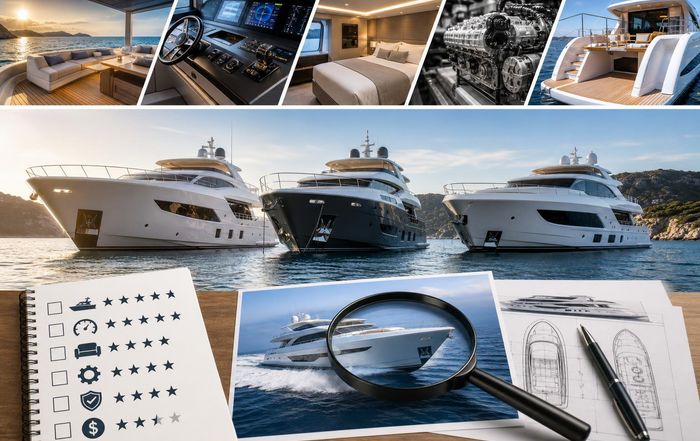
Before booking sea trials, many of our readers have already compared candidate yachts using a structured matrix that includes mission fit, hull and propulsion characteristics, layout, build quality, maintenance history, crew model, sustainability credentials and market positioning. This disciplined comparison narrows the field to those yachts that align both emotionally and rationally with the owner's objectives, ensuring that time on the water is spent making fine distinctions rather than discovering fundamental mismatches.
Complementary guidance on planning and interpreting sea trials can be found in our broader boats and yachts coverage and in historical perspectives on how yacht evaluation practices have evolved over decades in our history section. Together, these resources support buyers in approaching each acquisition not as an isolated purchase, but as a carefully considered chapter in a long-term yachting journey.
Conclusion: A Top Approach to Pre-Sea Trial Comparison
Comparing motor yachts before a sea trial demands both analytical rigour and an appreciation for the intangible qualities that make time on the water rewarding. By clarifying the mission, constructing a coherent shortlist, understanding hull and propulsion trade-offs, scrutinising layout and build quality, evaluating maintenance histories and crew requirements, and factoring in sustainability and market dynamics, buyers equip themselves to make decisions that stand the test of time.
For the professional and aspirational audience here, this structured approach transforms yacht selection from a purely aesthetic choice into a strategic exercise in experience design, capital allocation and responsible stewardship. With the right preparation, the sea trial becomes the final, satisfying step in confirming that a chosen yacht is not only beautiful and capable today, but also aligned with the owner's ambitions, values and global cruising plans for years to come.