

Review: An American-Built Luxury Motor Cruiser Redefining Blue-Water Comfort
A New Flagship Moment for American Yacht Building
As global yacht buyers scrutinize every new launch through the lens of craftsmanship, technological sophistication, and long-term reliability, an American-built luxury motor cruiser arriving on the scene carries a particular weight of expectation. For the editorial team at yacht-review.com, which has followed the resurgence of U.S. yacht building for more than a decade, this new 80-foot class motor cruiser-here reviewed as a representative flagship of the latest American approach to semi-custom luxury-feels less like a single product release and more like a statement of intent from an industry determined to compete head-to-head with the most established European yards.
American builders have long been recognized for robust hulls, practical engineering, and an instinctive understanding of long-range coastal and offshore cruising, especially for owners in the United States, Canada, and the broader North American market. What has evolved dramatically in the past five years, and what this cruiser embodies, is the fusion of that blue-water practicality with a level of interior refinement, hybrid propulsion technology, and digital integration that places it firmly in the top tier of global luxury offerings. Against the backdrop of changing owner expectations, tightening environmental regulations, and a rapidly professionalizing charter sector, this motor cruiser demonstrates how a U.S. yard can deliver not only comfort and performance, but also the Experience, Expertise, Authoritativeness, and Trustworthiness that discerning owners from the United Kingdom, Germany, Australia, France, Italy, Spain, the Netherlands, Switzerland, and Asia increasingly demand.
For readers already familiar with the editorial standards at yacht-review.com, this review sits alongside the site's broader portfolio of yacht evaluations and sea trials, which can be explored in greater depth through its dedicated reviews section. Within that context, this American-built cruiser stands out as one of the most mature and well-balanced motor yachts in its class to date.
Exterior Design: Confident Proportions and Ocean-Ready Lines
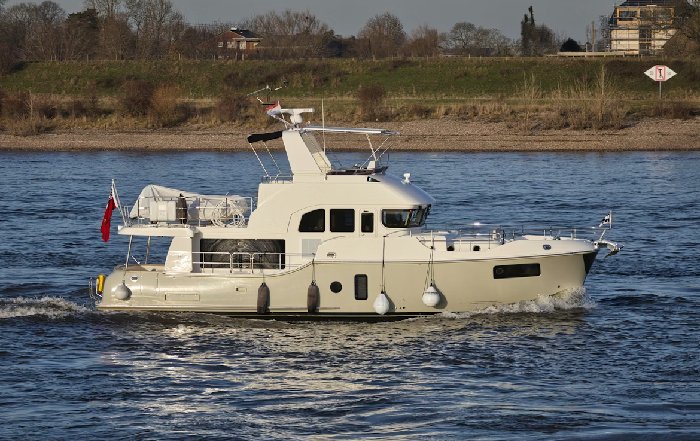
From the dock, the cruiser presents the kind of confident profile that signals long-range intent rather than marina-only posing. A high, subtly flared bow flows into a moderately raised foredeck, while the sheerline gently tapers aft, meeting a wide, teak-clad swim platform that doubles as a beach club and tender launch area. The superstructure is composed of clean, almost architectural planes with generous glazing, avoiding the over-styled curves that have dated some earlier generation models and instead leaning into a timeless, almost understated elegance.
The design language is unmistakably American in its emphasis on volume and practicality, yet it is executed with a level of refinement that would be equally at home in the marinas of the Mediterranean, the fjords of Norway, or the cruising grounds of Australia and New Zealand. Oversized side decks, high bulwarks, and secure railings reflect a safety-first philosophy particularly appreciated by family buyers from the United States, the United Kingdom, and Canada, while the carefully modeled hull form, with its fine entry and moderate deadrise aft, speaks to long-distance comfort and efficiency rather than pure top-end speed.
From a design analysis perspective, yacht-review.com has consistently emphasized that exterior styling must be evaluated not only for visual appeal but also for its impact on onboard experience, serviceability, and long-term maintenance. Readers interested in broader design trends can explore these themes through the site's design insights. In this case, the cruiser's designers have managed to integrate substantial glass surfaces without compromising structural integrity or weather protection, particularly important for owners intending to cruise in more demanding regions such as the Pacific Northwest, Scandinavia, or the Southern Ocean approaches.
A notable strength is the flybridge, which extends almost the full length of the superstructure, offering a large, partially enclosed upper salon, an alfresco dining area, and a helm station with commanding views. The use of a carbon-reinforced hardtop with integrated solar panels reflects the yard's commitment to modern energy management, aligning with broader industry developments covered by organizations such as the International Council of Marine Industry Associations and sustainability-focused research from bodies like the National Renewable Energy Laboratory, where owners can learn more about sustainable energy technologies.
Interior Layout and Living Experience
Stepping through the aft sliding doors into the main salon, the first impression is one of openness and light. Full-height windows, a nearly flat threshold from cockpit to salon, and an open-plan arrangement create a seamless connection between interior and exterior, an increasingly important consideration for owners from Europe, Asia, and South America who use their yachts as primary social spaces for family and corporate entertaining.
The salon layout is configured around a generous lounging area aft, with deep sofas and armchairs arranged to facilitate conversation rather than simply face a television. A formal dining area forward accommodates eight to ten guests, with careful attention paid to circulation paths so crew can serve discreetly even when the yacht is at capacity. Materials reflect a contemporary but warm American aesthetic: open-grain oak or walnut veneers, matte finishes to reduce glare, and a restrained palette of neutral textiles that can be adapted to regional tastes, whether for clients in Italy and France who favor bolder color accents, or for Scandinavian and Japanese owners who often prefer minimalist, monochrome schemes.
Forward on the main deck, the galley can be specified as either open or enclosed, a flexibility particularly valued by owners who alternate between private family cruising and charter operations. The galley design, with professional-grade appliances and ample cold storage, reflects a clear understanding of long-range provisioning requirements, which are often underestimated in this size range. For those who follow yacht-review.com's focus on practical cruising considerations, the attention to storage, ergonomics, and crew movement will resonate strongly with the site's cruising-oriented readership.
Below deck, the accommodation layout centers on a full-beam owner's suite amidships, where the yacht's maximum beam provides a sense of residential scale. Large hull windows, carefully positioned to maintain privacy while admitting natural light, frame water-level views that are especially dramatic when anchored off the coasts of Thailand, Greece, or the Bahamas. The suite includes a private lounge or office area, which many owners now use as a remote working hub, reflecting the increasing convergence of business and leisure travel. The en-suite bathroom, with twin basins, a walk-in shower, and optional bathtub, echoes the aesthetic of high-end boutique hotels rather than traditional marine design, yet remains practical in its use of non-slip surfaces and secure storage.
Guest accommodation typically comprises a VIP cabin forward and two twin or convertible cabins amidships, each with en-suite facilities. The layout is optimized for multigenerational use, with flexible berths that can adapt to families with children, couples, or corporate guests. For readers interested in family-oriented cruising, yacht-review.com provides additional guidance in its dedicated family section, and this cruiser aligns well with those priorities by offering privacy, sound insulation, and intuitive circulation patterns that minimize disturbance between cabins during night passages.
Crew quarters, located aft and accessed discretely from the cockpit or side deck, accommodate up to four crew in two cabins with a compact but well-equipped crew mess. This arrangement, while modest compared to larger superyachts, is thoughtfully designed to support professional crew operations on extended voyages, particularly for owners in regions such as the Mediterranean, Caribbean, and Southeast Asia, where full-season cruising is common and charter demand is robust.
Performance, Range, and Seakeeping
From a performance standpoint, the American-built cruiser is configured around twin diesel engines in the 1,300-1,600 horsepower range, depending on specification, delivering a top speed in the mid-20-knot bracket and an economical cruising speed of 12-16 knots. While some European competitors in this size range chase higher top speeds, the philosophy here is clearly oriented toward efficiency, range, and comfort, reflecting the long-distance cruising traditions of the United States and Canada, where passages along the Intracoastal Waterway, the Great Loop, or the Pacific coast demand a different balance of attributes.
The hull design, informed by computational fluid dynamics and extensive tank testing, delivers a stable, predictable ride in a variety of conditions. At displacement speeds, the cruiser exhibits excellent fuel economy and a reassuringly gentle motion, which will be particularly appreciated by owners traversing the North Atlantic between the United States and Europe, or exploring the more exposed waters off South Africa, Brazil, and New Zealand. At higher semi-planing speeds, the hull lifts cleanly without excessive bow rise, and the integration of advanced stabilizer systems-both underway and at anchor-significantly reduces roll, enhancing comfort for guests who may be less experienced at sea.
In terms of range, the yacht's fuel capacity and efficient propulsion package provide transoceanic capability at lower speeds, placing many of the world's prime cruising grounds within reach for an owner willing to plan passages carefully. For those researching broader trends in marine engineering and safety, organizations such as the American Bureau of Shipping and the International Maritime Organization offer technical resources and regulatory frameworks that shape how modern yachts are designed and certified, and interested readers can explore more about safety and regulatory standards in this context.
The engineering spaces themselves reflect the yard's reputation for practical, service-friendly layouts. The engine room offers good headroom, clear access to filters, seacocks, and electrical panels, and logical routing of piping and cabling, which significantly reduces maintenance time and costs over the vessel's lifecycle. For the professional captains and engineers who frequently contribute feedback to yacht-review.com's technology coverage, this cruiser's engineering execution is likely to be one of its strongest selling points.
Technology, Connectivity, and Digital Integration
One of the most striking aspects of this motor cruiser, and a clear differentiator in the 2026 market, is its integration of advanced digital systems and connectivity solutions. The yacht is built around a centralized vessel management system, integrating navigation, power management, tank monitoring, climate control, and entertainment into a unified interface accessible from the bridge, crew areas, and owner devices. This level of integration, once reserved for much larger superyachts, is now increasingly expected by tech-savvy owners from regions such as Singapore, South Korea, Japan, and the technology hubs of the United States and Europe.
On the navigation side, the bridge is equipped with large, multifunction displays, redundant chartplotters, radar, AIS, and thermal imaging cameras, providing a comprehensive situational awareness package. The helm ergonomics are carefully considered, with adjustable seating, clear sightlines, and intuitive placement of controls, enabling both owner-operators and professional captains to manage the vessel confidently in challenging conditions. For readers interested in how such systems evolve, resources from Garmin, Raymarine, and the National Marine Electronics Association provide additional context, while yacht-review.com continues to track these developments in its technology features.
Connectivity at sea has become a defining factor in the yachting experience, particularly for owners who blend leisure cruising with remote work or international business. This American-built cruiser offers a robust communications suite, combining VSAT, 5G cellular boosters, and Wi-Fi networking to deliver reliable internet coverage across most popular cruising regions, from the Mediterranean and Caribbean to parts of Asia and the Pacific. Industry analyses from organizations like the International Telecommunication Union help explain how maritime connectivity infrastructure is expanding, and those who wish to learn more about global communications standards will find useful background on the technologies underpinning modern onboard networks.
The integration of cybersecurity features, including firewalls, encrypted remote access, and regular software update protocols, reflects a growing recognition that yachts are not just physical assets but also digital platforms vulnerable to intrusion. This is an area where yacht-review.com has observed a rapid professionalization in the past five years, and the cruiser's builder appears to be working closely with specialized marine IT firms to ensure that the vessel's digital backbone is as robust as its physical structure.
Sustainability and Environmental Responsibility
In 2026, no serious review of a luxury motor cruiser can ignore the environmental dimension, and this American-built yacht demonstrates a measured but meaningful commitment to sustainability. The propulsion system is offered with optional hybrid assistance, incorporating electric motors for low-speed maneuvering and silent operation in environmentally sensitive anchorages. While not a fully electric yacht, the hybrid architecture reduces fuel consumption and emissions in typical day-to-day use, particularly during harbor transits and short coastal hops.
The yacht's hotel loads are supported by a combination of high-efficiency generators, lithium-ion battery banks, and rooftop solar arrays integrated into the flybridge hardtop. This configuration allows the vessel to operate for extended periods at anchor with reduced generator use, significantly lowering noise, vibration, and emissions. For owners and charter guests who value quiet anchorages in destinations such as the Greek Islands, the Norwegian fjords, or the remote bays of Thailand and Malaysia, this is more than a technical feature; it is a direct enhancement of the onboard experience.
Sustainable materials and construction practices are also increasingly central to buyer decision-making. The builder has incorporated certified sustainably sourced woods, low-VOC finishes, and advanced insulation materials that improve energy efficiency while minimizing environmental impact. Industry-wide initiatives led by organizations such as the World Sailing Trust and research from academic institutions covered by platforms like the World Bank's climate reports have helped shape these practices, and readers can learn more about sustainable business practices that are influencing the broader marine sector.
For a deeper dive into environmental issues specific to yachting, yacht-review.com maintains a dedicated sustainability channel, where developments in alternative fuels, lifecycle analysis, and regulatory changes are examined in detail. Within that context, this motor cruiser does not claim to be a radical departure from conventional yacht design, but it does represent a thoughtful and credible evolution toward lower-impact luxury, aligning with the expectations of younger owners in Europe, Asia, and North America who are increasingly vocal about environmental responsibility.
Ownership Experience, Business Considerations, and Global Appeal
From an ownership perspective, the American-built cruiser is positioned as a semi-custom platform, allowing buyers to tailor interior layouts, finishes, and technical specifications to their regional cruising patterns and personal preferences. This flexibility is particularly appealing to sophisticated clients from markets such as Germany, Switzerland, and the Netherlands, where engineering-driven customization is highly valued, as well as to entrepreneurial owners in the United States, the United Kingdom, and Asia who view their yachts as both lifestyle assets and potential charter revenue generators.
The builder's approach to after-sales support and warranty coverage is a critical component of its value proposition. With service networks and partner yards across North America, Europe, and key Asian hubs such as Singapore and Hong Kong, the yard aims to provide a consistent ownership experience regardless of where the yacht is based. For business-minded readers of yacht-review.com, the implications of such support structures are explored more broadly in the site's business analysis section, where topics such as residual values, financing, and fleet management receive close attention.
Charter viability is another dimension that cannot be overlooked in 2026. The yacht's layout, with four guest cabins, generous deck spaces, and strong crew accommodations, lends itself well to high-end charter operations in popular destinations including the Mediterranean, Caribbean, and Southeast Asia. Regulatory frameworks, consumer protection standards, and best practices for charter management are extensively documented by bodies such as MYBA - The Worldwide Yachting Association, and potential owners interested in offsetting operating costs through charter may wish to explore more about professional charter standards.
For globally mobile owners, the cruiser's design acknowledges the practical realities of operating in diverse regions, from the marina infrastructures of the United States and Europe to the emerging yachting hubs of China, Thailand, and Brazil. Air-conditioning capacity, insulation, and glazing specifications can be tuned for tropical or temperate climates; electrical systems support multiple shore-power standards; and the tender and toy storage solutions are adaptable to regional preferences, whether that means dive-focused operations in Southeast Asia and South Africa or watersports-oriented setups in Florida, Spain, and Australia.
As with all major acquisitions in the luxury sector, buyers benefit from independent, experience-driven perspectives. yacht-review.com, drawing on its global readership and expert contributors, continues to contextualize individual yacht reviews within broader market trends, and those wishing to compare this cruiser against other offerings can explore its coverage of boats and models across multiple segments, as well as its regularly updated news reports tracking launches, mergers, and regulatory developments.
Lifestyle, Community, and the Evolving Culture of Motor Cruising
Beyond the technical specifications and financial considerations, the true measure of any luxury motor cruiser lies in the lifestyle it enables. This American-built yacht is conceived as a platform for experiences: family voyages along the U.S. East Coast, exploratory cruises in the Baltic and Mediterranean, extended seasons in the Caribbean, or even ambitious passages across the Pacific to explore the islands of Japan, Fiji, or French Polynesia. Its design facilitates both intimate family moments and larger social gatherings, offering spaces that can transition from casual daytime relaxation to formal evening entertaining without feeling compromised in either mode.
The rise of owner communities, both online and through in-person events, has also reshaped how yachts are used and perceived. Owners and enthusiasts increasingly seek not only vessels but also a sense of belonging to a global network of like-minded individuals. yacht-review.com has observed this shift closely and reflects it in its community features and lifestyle coverage, where the cultural aspects of yachting-from culinary trends and design collaborations to philanthropic initiatives and environmental stewardship-are explored alongside traditional performance metrics.
For many in the new generation of yacht owners from North America, Europe, Asia, and Africa, a motor cruiser of this caliber is as much a mobile home, office, and social hub as it is a means of transportation. The ability to combine work, family, and leisure in a single, self-contained environment has become a powerful draw, especially in a post-pandemic world where flexibility and mobility are highly prized. This American-built cruiser, with its carefully considered interior spaces, robust connectivity, and long-range capabilities, is particularly well suited to this evolving definition of yacht ownership.
Events such as international boat shows, owner rallies, and regional regattas continue to play a central role in building relationships and sharing best practices among owners, captains, and industry professionals. The global calendar of such gatherings, often highlighted in yacht-review.com's events coverage, provides multiple opportunities for prospective buyers to experience this cruiser firsthand, compare it with its peers, and gather unfiltered feedback from existing owners and crew.
Conclusion: A Mature, Confident Expression of American Yacht Craft
In assessing this American-built luxury motor cruiser for 2026, the editorial team at yacht-review.com is struck by its sense of maturity and balance. It does not chase extremes of speed, radical styling, or unproven technologies; instead, it delivers a coherent, thoroughly thought-out package that aligns with the real-world needs of experienced owners who value reliability, comfort, and long-term support as much as they value aesthetics and innovation. The yacht's strengths-its seaworthy hull, well-resolved interior layout, advanced but user-friendly technology, and credible sustainability features-combine to create a vessel that feels ready for serious, global cruising.
For buyers in the United States, Canada, and across North America, this cruiser offers the reassurance of domestic build quality and service access, coupled with a level of sophistication that stands comfortably alongside leading European competitors. For owners in Europe, Asia, Africa, and South America, it presents a compelling alternative that brings a distinctly American sensibility to long-range motor cruising, emphasizing practicality, resilience, and understated luxury.
As always, yacht-review.com encourages prospective owners to go beyond brochures and marketing materials, to sea-trial vessels in varied conditions, to speak with captains and engineers, and to consider how a particular yacht aligns with their specific cruising ambitions, family dynamics, and business objectives. Within that broader decision-making framework, this American-built luxury motor cruiser emerges as one of the most convincing options in its class, a yacht that reflects not only the craftsmanship of its builder but also the evolving aspirations of a global community of yacht owners in 2026. Those wishing to situate this review within the wider landscape of yachting trends, destinations, and historical context can explore the main portal of yacht-review.com at yacht-review.com, where design, technology, travel, and business perspectives converge to support informed, experience-driven decisions.