

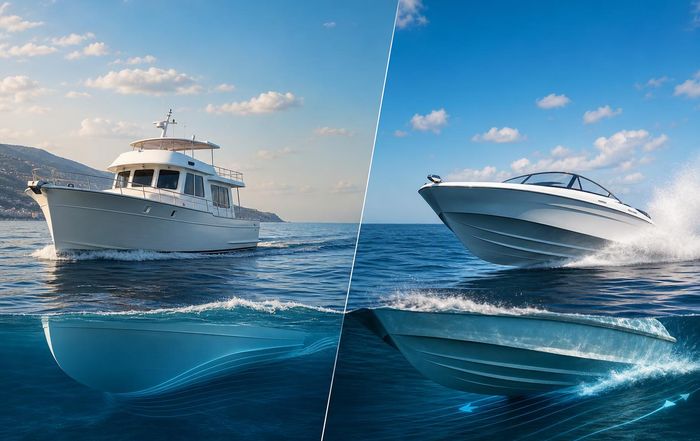
Understanding Displacement and Planing Hulls
Why Hull Form Still Matters More Than Ever
For owners captains and designers online now the distinction between displacement and planing hulls is not an abstract naval architecture concept; it shapes cruising range, comfort at sea, fuel budgets, onboard lifestyle and even the type of destinations that can realistically be reached in a given season. As yacht sizes, propulsion technologies and owner expectations evolve, the traditional line separating displacement and planing craft has blurred, yet the underlying hydrodynamic principles remain decisive.
This article explores how displacement and planing hulls work, how they have developed in modern yacht design, and what practical implications they carry for buyers and operators. It draws on contemporary naval architecture research, recent market developments and the experience of designers and shipyards who sit at the forefront of superyacht and performance-boat innovation.
Individuals who want to go deeper into specific models and case studies can complement this overview with detailed yacht evaluations in the updated reviews section, where many of these principles are illustrated by real vessels.
The Hydrodynamic Foundations
At the most fundamental level, the difference between displacement and planing hulls lies in how they generate support in the water. A displacement hull is supported primarily by buoyancy: the hull pushes water aside and settles into the trough it has created, and the weight of displaced water equals the weight of the vessel. A planing hull, by contrast, is designed to generate substantial hydrodynamic lift as speed increases, allowing the hull to rise and skim over the water's surface rather than pushing through it.
These two modes of operation can be described using the Froude number, a dimensionless quantity widely used in naval architecture to compare speed, length and wave-making effects. As explained by ABS and other classification societies, lower Froude numbers correspond to classic displacement operation, while higher Froude numbers indicate semi-displacement and full planing regimes. Readers who wish to explore the underlying mathematics and model testing techniques can consult resources from organizations such as The Royal Institution of Naval Architects, which regularly publishes technical papers on hull form optimization.
While these hydrodynamic principles are universal, their practical implications diverge sharply depending on whether the yacht is intended for blue-water passages at moderate speeds, high-speed coastal cruising, or a hybrid profile that attempts to reconcile both.
Displacement Hulls: Endurance, Comfort and Predictability
Traditional displacement hulls, such as those seen on classic trawlers, many long-range explorers and larger superyachts, are optimized to move efficiently at relatively low to moderate speeds, typically in the range of 8 to 15 knots depending on waterline length. Their rounded or moderately V-shaped sections, full bows and deeper drafts create a stable, predictable platform, particularly appreciated on ocean passages where comfort and range outweigh the desire for outright speed.
Displacement hulls tend to have lower fuel consumption per nautical mile at their design speed than comparable planing yachts, especially when paired with optimized propeller and shaft arrangements. This efficiency contributes to the impressive ranges advertised by long-range motor yachts and explorers, which can cross oceans with minimal refuelling stops. Classification societies such as Lloyd's Register and Bureau Veritas have noted in technical guidance that displacement hulls generally achieve lower specific fuel consumption at steady, moderate speeds, which aligns well with the operating profiles of many transoceanic vessels.
From the owner's perspective, the most tangible advantage of a displacement yacht is motion comfort. The hull's deeper immersion, higher displacement and often lower center of gravity combine to reduce accelerations in a seaway, while active stabilizer systems further dampen roll. For those planning extended cruising itineraries, such as circumnavigations or seasonal passages between the Mediterranean and Caribbean, this comfort translates into less fatigue for guests and crew, and a higher likelihood that the yacht will maintain schedule regardless of moderate weather conditions.
On Yacht Review, this philosophy of slow, steady voyaging is explored in depth in the cruising section, where displacement explorers and passagemakers are frequently highlighted for their ability to open up remote destinations with a high degree of self-sufficiency.
Planing Hulls: Speed, Responsiveness and Coastal Freedom
Planing hulls, by contrast, are crafted for speed and agility. Characterized by flatter aft sections, sharper deadrise angles and reduced wetted surface at speed, they are designed to climb onto the plane, reducing drag and allowing significantly higher top speeds than a displacement vessel of similar length and power. Many high-performance motor yachts, sport cruisers and chase boats fall into this category.
The hydrodynamic lift that defines planing operation is generated as water flows rapidly under the hull, creating a pressure differential that supports a large proportion of the vessel's weight. This allows a properly designed planing yacht to achieve 25, 30 or even 40 knots, depending on power and loading. Builders and engine manufacturers such as Sunseeker, Pershing and MTU have made significant investments in hull optimization, propulsion integration and weight reduction to push the performance envelope while maintaining acceptable seakeeping.
From a lifestyle perspective, planing yachts offer compelling advantages for owners whose priorities center on day boating, short coastal hops and the ability to reach multiple destinations in a single weekend. A planing hull can depart from a marina on the Côte d'Azur, run at 30 knots to a lunch reservation in Corsica, and return before nightfall, an itinerary that would be impractical at displacement speeds. This flexibility resonates strongly with buyers in markets such as the United States, Mediterranean Europe and Australia, where coastal attractions are densely spaced and time on board is often concentrated in short, high-intensity bursts.
The trade-off is fuel consumption and, in some conditions, comfort. At high speeds, planing yachts generally burn significantly more fuel per nautical mile than displacement vessels, especially when heavily loaded or operating in adverse sea states. Their flatter hull sections can also result in a harder ride in short, steep chop, although advances in hull geometry, interceptors and ride control systems have mitigated this to some extent. For readers interested in how these performance-oriented designs translate into day-to-day ownership, the Yacht-Review boats overview provides context across a range of sizes and builder philosophies.
Semi-Displacement and the Blurring of Boundaries
In recent decades, the industry has seen a significant rise in semi-displacement or "fast displacement" hulls that aim to bridge the gap between traditional displacement efficiency and planing performance. These hulls operate in a transitional regime, generating some hydrodynamic lift at higher speeds while still relying substantially on buoyancy. The result is a compromise that allows higher cruising speeds than classic displacement yachts, often in the 16 to 22 knot range, while retaining reasonable efficiency and seakeeping.
Several European and global builders have invested in proprietary semi-displacement hull technologies, supported by computational fluid dynamics and extensive tank testing. Independent research published by institutions such as Delft University of Technology has contributed to the understanding of how hull volume distribution, chine placement and stern shape influence resistance and lift in this mixed regime. The commercial success of these designs suggests that many owners value an intermediate solution: a yacht that can cruise comfortably at moderate speed for long distances, yet still has the ability to accelerate and outrun weather systems or compress passage times when needed.
From a business standpoint, semi-displacement concepts have allowed shipyards to address a broader spectrum of client preferences without having to commit entirely to either extreme of the speed-range continuum. For example, a 35-metre yacht with a semi-displacement hull can be marketed both to traditional cruisers upgrading from classic displacement vessels and to performance-oriented owners who are willing to trade some top speed for improved range and comfort. This flexibility has been particularly valuable in markets such as Northern Europe and North America, where cruising patterns often combine extended passages with faster regional transits.
Design Considerations: Form, Function and Aesthetics
When naval architects set out to design a displacement or planing hull, they must balance hydrodynamic efficiency, interior volume, aesthetic appeal and regulatory constraints. The hull form dictates not only performance but also how the interior can be arranged, how much storage is available for tenders and toys, and how the yacht will sit at anchor.
Displacement yachts often feature fuller bows, deeper bilges and more volume below the waterline, which supports generous tankage and storage as well as technical spaces for systems redundancy. This configuration lends itself well to long-range cruising and expedition-style yachts, where reliability and autonomy are paramount. Planing yachts, on the other hand, typically favor a more aggressive sheer line, lighter construction and carefully managed weight distribution to support quick acceleration and high-speed stability. Builders may use advanced composites, vacuum infusion and carbon fiber reinforcement to reduce displacement without compromising structural integrity, drawing on technical expertise documented by organizations such as DNV.
The interplay between hull form and lifestyle is a recurring theme on Yacht-Review.com, particularly in the design and lifestyle sections, where exterior styling, deck layouts and interior concepts are evaluated in the context of the yacht's underlying performance profile. A sleek, low-profile planing yacht may offer dramatic open decks and beach club areas optimized for warm-weather day use, while a high-bow displacement explorer might emphasize enclosed observation lounges, protected side decks and generous crew quarters for long voyages.
Operational Realities: Crewing, Maintenance and Weather Windows
Beyond the theoretical advantages of each hull type, operational experience reveals practical differences that owners and captains must consider. Displacement yachts, by virtue of their slower speeds, require more careful passage planning to account for weather systems and currents, yet their seakeeping often allows them to continue safely in conditions that would be uncomfortable or inefficient for a planing craft. Planing yachts, in turn, can exploit speed to avoid deteriorating conditions, but may face limitations if sea states become too severe to maintain planing speeds comfortably.
Crewing requirements also differ subtly. A large displacement yacht with complex systems and global cruising ambitions may require a more experienced crew with strong engineering capabilities, as the vessel is expected to operate far from shore-based support. High-performance planing yachts, while sometimes simpler in systems architecture, demand crews who are proficient in high-speed handling, trim optimization and the maintenance of advanced propulsion systems such as surface drives, waterjets or pod drives. Professional training guidance from organizations like The Nautical Institute frequently highlights the importance of understanding vessel-specific handling characteristics, particularly at speed or in confined waters.
Maintenance profiles reflect these differences as well. Planing yachts operating at high speeds subject hulls, running gear and machinery to greater dynamic loads, which can translate into more intensive inspection and preventive maintenance schedules. Displacement yachts, running at lower loads and speeds, may experience less wear in some areas but must manage long-term issues such as fouling, corrosion and the cumulative effects of extensive time at sea. Owners and managers who follow the Yacht-Review business coverage will recognize how these operational realities feed into total cost of ownership calculations and long-term asset management strategies.
Sustainability and Efficiency: Hull Form in a Changing Regulatory Landscape
Environmental considerations and evolving regulations are reshaping how shipyards and designers approach hull form selection. While it would be simplistic to label displacement hulls as inherently "green" and planing hulls as "wasteful," the operating profiles associated with each type have significant implications for fuel consumption and emissions. Displacement yachts that cruise steadily at moderate speeds generally achieve lower greenhouse gas emissions per nautical mile than similarly sized planing yachts running at high speed, though actual performance depends on many factors including hull efficiency, propulsion type and load.
International frameworks such as the International Maritime Organization's energy efficiency regulations, as well as growing owner interest in sustainable yachting, have encouraged designers to refine hull shapes for minimal resistance at target speeds, optimize propeller and rudder interactions, and consider alternative propulsion solutions. Hybrid propulsion, battery-assisted hotel loads and even experimental fuel cell systems are being paired with both displacement and semi-displacement hulls to reduce environmental impact without compromising range or comfort.
For those following developments in sustainable yachting, the Yacht-Review sustainability section provides continuing coverage of how hull design, materials and propulsion innovations intersect. External industry initiatives, such as the Water Revolution Foundation, are also promoting life-cycle assessments and eco-design principles that increasingly influence hull form decisions at the concept stage.
Regional Preferences and Market Trends
Global market data from brokerage houses and industry analysts indicates that regional preferences continue to shape demand for displacement and planing yachts. In the United States and parts of the Mediterranean, there is strong interest in fast planing and semi-displacement yachts in the 15 to 35-metre range, reflecting a culture of weekend cruising, sport fishing and coastal resort hopping. Northern Europe, by contrast, often shows a higher proportion of displacement and explorer-style yachts, aligned with a tradition of longer passages, higher latitudes and more variable weather.
In Asia-Pacific markets such as Australia, New Zealand and parts of Southeast Asia, a mix of fast coastal cruisers and robust displacement yachts can be observed, shaped by local geography and regulatory environments. Industry reports from organizations like Superyacht Times and Boat International have highlighted the growing popularity of explorer yachts capable of reaching remote regions such as Antarctica, the Arctic and the South Pacific, a trend that naturally favors displacement hull forms with ice-class or reinforced structures.
At the same time, advances in materials, computational design and propulsion are enabling larger yachts to achieve higher speeds without abandoning the comfort and volume associated with displacement operation. This has given rise to a new generation of "fast superyachts" that blur traditional categories, offering owners a combination of long-range capability and impressive sprint speeds. Coverage in the Yacht-Review news and global sections frequently highlights these innovations, providing context on how leading shipyards position their latest launches within this evolving landscape.
Owner Decision-Making: Matching Hull Type to Lifestyle
For prospective buyers, the choice between a displacement and planing hull should begin with an honest assessment of intended use. Those who envision extended cruising seasons, high-latitude exploration or transoceanic passages with family and friends are likely to derive more value from a well-designed displacement or semi-displacement yacht that prioritizes range, comfort and seakeeping. Owners whose time on board is concentrated in weekends, holidays and short coastal trips may find that a fast planing yacht better aligns with their desire for spontaneity and rapid access to multiple destinations.
Charter intentions also play a role. In popular charter regions such as the Western Mediterranean and the Bahamas, where guests often request rapid relocation between anchorages and marinas, a planing or semi-displacement yacht can offer commercial advantages. Conversely, for expedition charters in destinations such as Norway, Greenland or the South Pacific, displacement explorers with robust hulls and ample storage are more suitable. Insights from the Yacht-Review travel and cruising features can help potential owners visualize how different hull types perform across these varied itineraries.
Another factor is onboard culture. Some owners prioritize the journey itself, valuing slow, contemplative passages where wildlife watching, fishing and long conversations on deck are central to the experience. Others view the yacht primarily as a mobile base for water sports, nightlife and shore excursions, where speed is a means of maximizing time spent at the destination. The hull form, in this sense, becomes an expression of personal philosophy about what yachting should be.
Looking Ahead: Innovation, Integration and Informed Choices
As naval architecture continues to advance, the binary distinction between displacement and planing hulls is becoming less rigid, yet understanding these foundational concepts remains essential for making informed decisions. Hybrid hull forms, active ride control, foiling appendages and integrated propulsion systems are expanding what is possible, allowing designers to tailor performance envelopes more precisely to owner requirements.
For the Yacht-Review.com audience, staying informed about these developments is not merely a matter of technical curiosity; it is a way to protect long-term investment, enhance safety and ensure that the chosen yacht genuinely supports the lifestyle and cruising ambitions of its owner. The platform's technology pages frequently examines how innovations in hydrodynamics and propulsion move from experimental prototypes into mainstream production, while the history section provides valuable perspective on how far hull design has come since the early days of motor yachting.
Ultimately, whether a yacht rides on a deep, steady displacement hull or leaps onto the plane at the touch of the throttles, success lies in alignment: the alignment of hull form with mission profile, of engineering with aesthetics, and of owner expectations with the realities of life at sea. By understanding the strengths and limitations of displacement and planing hulls, and by engaging with designers, surveyors and trusted brokers, today's yacht owners can navigate this choice with confidence and clarity.
For ongoing analysis, comparative reviews and expert commentary on how these principles play out across specific models and real-world cruising experiences, readers are invited to explore the broader content here every day, where hull form is always considered in the context of the complete yachting experience.