

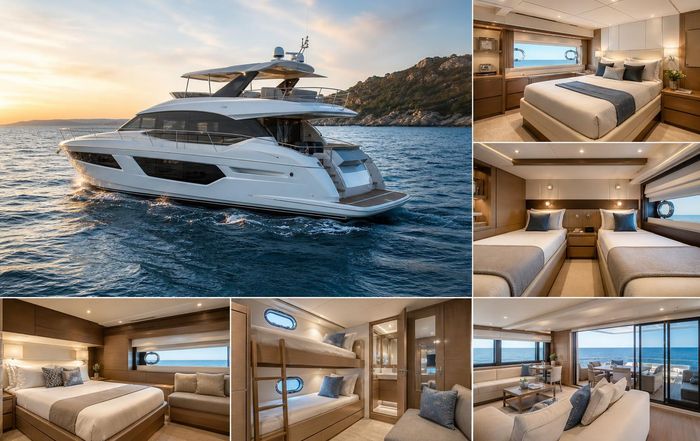
Top Cabin Layouts for Family Cruising Yachts
Family cruising is reshaping expectations of what a yacht should feel like below deck. Where earlier generations often accepted compact bunks and minimal privacy as the price of life afloat, contemporary family owners increasingly seek layouts that work as well for a week of remote work and school as for a long summer cruise. Across the fleet that we follow, designers and builders are responding with cabin arrangements that emphasise flexibility, safety, quiet sleeping spaces and convivial family areas, while still honouring the seagoing discipline that has always defined serious cruising yachts.
This page explores the cabin concepts that are proving most successful for family cruisers, drawing on recent production and semi-custom sailing and motor yachts, together with the perspectives of naval architects, interior designers and brokers who specialise in family programmes. It focuses on real-world solutions already visible in the marketplace, and on how those ideas translate into better experiences for parents, children and multi-generational groups.
From "Couple Plus Occasional Guests" to True Family Platforms
For many years, the dominant layout in production cruising yachts was oriented around a cruising couple with the option to host another couple or a few occasional guests. The classic configuration, particularly on sailing yachts from builders such as Beneteau, Jeanneau and Bavaria, placed a generous owner's cabin either forward or aft, one or two compact guest cabins, and a saloon that could convert into extra berths. This arrangement suited charter operators and private owners who spent a few weeks a year on board.
As more owners began using yachts as seasonal homes, floating offices or long-range cruisers, expectations shifted. Builders report that a growing share of clients now specify layouts optimised for families with children of different ages, sometimes including grandparents and caregivers, and often expecting to host friends as well. The rise of family world cruising, well documented by organisations such as the World Cruising Club, has reinforced this trend, with many boats on rallies such as the ARC carrying school-age children and teenagers for extended passages. Owners looking for guidance on such bluewater programmes increasingly turn to specialist resources; for example, the World Cruising Club provides practical information on family ocean sailing and route planning through its official site at worldcruising.com.
For yacht-review.com readers, this evolution is apparent not only in new-build specifications but also in the refit choices made by families upgrading existing boats. Interior modifications often prioritise additional cabins, improved storage for children's gear and better separation between quiet and social zones, themes that recur across the most successful layouts.
The Three-Cabin Baseline: A Versatile Foundation
On monohull sailing yachts between roughly 38 and 48 feet, the three-cabin configuration has become the baseline for family cruising. Typically this includes an owner's cabin and two guest cabins, often with two heads. Within this familiar template, small decisions in geometry and access create large differences in liveability.
Many successful family layouts position the owner's cabin forward with an island berth and generous storage, while two symmetrical or near-symmetrical aft cabins house children or guests. This approach, visible in several models from Hallberg-Rassy, X-Yachts and Oyster Yachts, gives parents a sense of retreat and allows children to share aft cabins that are close to the cockpit companionway and the heart of the boat's activity.
From a safety and comfort perspective, designers interviewed by publications such as Yachting World and Cruising World have emphasised that berths used at sea should offer secure lee cloths, handholds and the ability to sleep on either tack. Families who expect to undertake overnight passages often favour layouts where at least one berth in each cabin functions as a genuine sea berth, rather than only as a wide island bed optimised for marina life. Owners researching this trade-off can find deeper technical context in specialist bluewater discussions on sites like noonsite.com, which collates practical reports from long-distance cruisers.
For readers of yacht-review.com, this three-cabin format frequently appears in our own boat reviews, where the most family-friendly examples combine direct access to a head from the owner's cabin, sensibly sized wardrobes for longer trips and enough floor area in at least one cabin to manage dressing young children or storing bulky sports equipment.
Four Cabins and Beyond: Space for Growing Families
Once yachts reach around 50 feet in length for monohulls or 45 feet and above for multihulls, four-cabin layouts become viable without compromising structural integrity or tankage. For larger families or those regularly hosting friends, the additional cabin transforms how the boat can be used.
In the sailing multihull sector, builders such as Lagoon, Fountaine Pajot and Bali Catamarans have popularised four-cabin, four-head configurations on boats between 45 and 55 feet. Each hull typically houses two cabins with en-suite heads, giving every family member or couple a private domain. Catamarans' inherent beam allows for generous berth sizes and large hull windows, which reduce the sense of being in a confined space and are particularly appreciated by children and teenagers. Interested readers can explore wider trends in multihull design and comfort in resources such as Multihulls World at multihulls-world.com.
Monohull builders have responded with innovative four-cabin variants, sometimes sacrificing a portion of the traditional longitudinal galley or storage to create a bunk cabin suitable for children or crew. On semi-custom and custom yachts, naval architects increasingly report requests for "flex cabins" that can alternate between twin bunks, a double berth or a workspace, depending on the family stage and cruise profile.
For yacht-review.com's audience, particularly those following our boats and models coverage, the key question is how these extra cabins affect the yacht's core performance and systems. Well-executed designs preserve tank capacities, maintain good access to machinery and avoid compromising structural bulkheads, ensuring that the family comfort gained below deck does not come at the expense of seaworthiness.
Bunk Rooms and Children's Cabins: Designing for Younger Crew
One of the most distinctive developments in family-oriented layouts is the dedicated children's cabin, often configured as a compact bunk room. Instead of treating children as small adults who simply occupy standard guest cabins, many owners now request spaces tailored to younger users.
A successful children's cabin typically includes two or three bunks with robust guardrails, easily accessible reading lights and USB charging points, and generous cubby-style storage that encourages children to manage their own belongings. Designers also pay attention to sound insulation between children's cabins and the main saloon or owner's cabin, recognising that different age groups keep different hours.
Some of the most effective bunk rooms are located near the centre of the boat, where motion is least pronounced, reducing seasickness and making it easier for children to sleep during passages. On catamarans, this often means placing the bunk room amidships in one hull; on monohulls, it might occupy the space traditionally used for a technical room or workshop, with careful planning to retain essential systems access.
Educational considerations also influence these cabin designs. Families engaged in long-term cruising frequently adopt some form of home schooling or online learning, a trend that accelerated with the broader adoption of remote education technologies. Organisations such as Cruising Association and various national distance-learning providers have documented the practical requirements of schooling at sea, from stable internet connectivity to quiet desk space, and families increasingly ask designers to integrate small study areas or fold-down desks into children's cabins rather than relying solely on the main saloon.
For readers tracking interior innovation on yacht-review.com, our design features have highlighted projects where convertible furniture, sliding partitions and modular storage allow a single cabin to evolve from playroom to bunk room to teenage retreat over the life of the family's ownership, illustrating how thoughtful design can extend the usefulness of a given hull for many years.
The Owner's Suite as a True Retreat
While family-oriented layouts rightly focus on shared spaces and children's needs, the best designs also protect a sense of sanctuary for the adults who carry the primary responsibility for navigation, maintenance and safety. The owner's suite has therefore become more carefully considered, even on relatively modest-sized yachts.
On many contemporary cruising yachts, particularly in the 45- to 60-foot range, the owner's suite often occupies the full beam either forward or aft, featuring an island berth, dedicated seating, and an en-suite head with separate shower. Builders such as Oyster, Hallberg-Rassy and Contest Yachts have refined these arrangements to offer generous headroom, abundant natural light and substantial wardrobe space, enabling owners to live aboard for extended periods without feeling constrained.
Privacy is enhanced by separating the owner's suite circulation from the main traffic routes. For example, access may be via a private companionway or a short corridor that does not double as the path to other cabins. Sound insulation, soft-close doors and careful positioning of machinery spaces further contribute to a quiet environment where owners can rest even when other family members are awake in the saloon or cockpit.
Well-designed owner's suites also integrate functional storage for navigation gear, personal electronics and documents, reflecting the reality that many owners now work remotely while cruising. The increasing prevalence of reliable VSAT and 4G/5G connectivity, documented by marine technology providers such as KVH Industries and Inmarsat, has turned yachts into viable mobile offices, and cabin layouts have adapted accordingly. For readers interested in the technical side of this transformation, more detail on communications and onboard systems can be found through our coverage of yachting technology.
Flexible Cabins: Multipurpose Spaces for Modern Families
Perhaps the most significant philosophical shift in family yacht interiors is the move away from rigidly defined cabin roles towards flexible, multipurpose spaces. Rather than dedicating a room solely as a guest cabin that sits empty when friends are not aboard, many owners prefer a space that functions as an office, media room, gym or workshop in daily use, while still converting quickly into a comfortable bedroom.
This flexibility is achieved through furniture that transforms, such as sofas that slide into double berths, Pullman bunks that fold out from the bulkhead, and desks that pivot or lower to create additional sleeping surfaces. Storage is designed to accommodate both everyday equipment and occasional bedding without cluttering the room. Lighting schemes often include separate modes for work, relaxation and sleep, reinforcing the space's adaptability.
On some larger semi-custom yachts, particularly in the 70- to 90-foot range, designers report increasing demand for "bonus rooms" that can be reconfigured over the life of the yacht as family circumstances change. A cabin that begins as a nursery might later evolve into a study or fitness room and eventually serve as a dedicated guest suite, extending the yacht's relevance and resale appeal. The logic mirrors trends in high-end residential architecture, where flexible rooms accommodate shifting family dynamics.
These ideas align closely with the evolving lifestyle narratives that our news and research team explores in its lifestyle coverage, where yachting is presented not merely as a vacation activity but as an integrated part of work, education and family life.
Crew Cabins: Balancing Privacy and Integration
For many family programmes, particularly on motor yachts above 70 feet or sailing yachts above 60 feet, professional crew are an essential part of safe and enjoyable cruising. Crew accommodation, once treated as an afterthought, now plays a significant role in how well a family yacht functions day to day.
Successful family-oriented layouts position crew cabins in a way that allows team members to move between their accommodation, the galley and service areas, and the exterior decks without constantly passing through family spaces. This might mean placing crew cabins forward with a dedicated access from the foredeck on sailing yachts, or aft near the transom with a private stair on motor yachts. At the same time, many families prefer a degree of integration, particularly with long-standing crew who may be closely involved in children's lives, so layouts often allow easy access to the main saloon and family areas when appropriate.
Modern crew cabins increasingly offer improved comfort, including better natural light, more generous headroom and thoughtful storage, recognising that a well-rested crew contributes directly to safety and service quality. Industry bodies such as the Professional Yachting Association (PYA) and regulatory frameworks under the Maritime Labour Convention (MLC 2006) have reinforced minimum standards for crew accommodation, influencing how designers allocate space even on privately registered yachts. Those seeking a deeper understanding of these regulatory impacts can consult official explanatory materials provided by the International Labour Organization at ilo.org.
From the family's perspective, well-designed crew cabins help maintain a clear boundary between private and service spaces, allowing parents and children to relax without feeling constantly observed, while still benefiting from professional support. This balance is particularly important on longer voyages or when using the yacht as a seasonal home.
Integrating Cabins with Social and Outdoor Spaces
Cabin layouts cannot be assessed in isolation; their success depends on how they connect to the saloon, galley, cockpit and exterior decks. Families spend much of their time on board moving between these zones, and circulation patterns have a profound effect on perceived space and comfort.
On many contemporary cruising yachts, the main saloon functions as the social hub, with cabins radiating from a central companionway. Designers aim to create clear sightlines and intuitive paths so that children can move safely from cabins to the cockpit without navigating complex steps or tight doorways. Handholds, non-slip surfaces and good lighting are essential, particularly for night-time movement.
The relationship between cabins and the galley is also important. In family contexts, galleys are often in near-constant use, and layouts that place children's cabins too close to cooking and cleaning zones can lead to noise and disturbance. Some of the better solutions place the galley slightly offset from the main cabin corridor, sometimes in a raised or lowered position, which preserves convenient access while limiting direct sound transmission.
On catamarans, the saloon is typically at bridgedeck level with cabins in the hulls, and the challenge becomes ensuring that movement between hulls and the central living space remains safe and convenient, particularly in rough weather. Builders have improved stair geometry, handrail placement and lighting in response to owner feedback, recognising that family crews may include people of widely varying ages and mobility levels.
These design refinements echo a broader shift towards holistic thinking about life on board, a theme that yacht-review.com explores in its reporting of cruising experiences, where cabin comfort is always considered alongside deck ergonomics and underway behaviour.
Sustainability and Health: Materials and Ventilation Below Deck
Family owners are increasingly attentive to the environmental and health implications of the materials used in their cabins. Concerns about volatile organic compounds (VOCs), off-gassing from adhesives and finishes, and the long-term impact of synthetic materials in marine environments have prompted builders to experiment with more sustainable and low-emission options.
Some premium yards now specify wood from certified sustainable forests, low-VOC varnishes and adhesives, and recycled or recyclable fabrics where practical. Marine-grade cork, bamboo and other rapidly renewable materials are appearing in soles and decorative elements, while high-performance insulation reduces the need for constant air-conditioning, improving energy efficiency. For readers interested in the broader context of sustainable design and operations, organisations such as the Water Revolution Foundation at waterrevolutionfoundation.org provide insight into industry-wide efforts to reduce yachting's environmental footprint.
Ventilation has also become a priority, both for comfort and health. Well-designed cabin layouts incorporate a combination of opening hatches, dorade vents, forced-air systems and, where appropriate, air-conditioning, ensuring that cabins remain dry and fresh in a wide range of climates. Good airflow reduces the risk of mould and mildew, a particular concern for families with young children or allergy sensitivities.
Within our own focus on sustainability in yachting, cabin design is increasingly highlighted as an area where incremental improvements in materials, insulation and systems can yield meaningful gains in comfort and environmental performance without compromising aesthetics or craftsmanship.
Regional and Cultural Influences on Family Cabin Layouts
Family expectations of cabin arrangements are not uniform worldwide; they reflect regional cruising patterns, cultural norms and regulatory frameworks. Builders serving the North American and Northern European markets often prioritise robust heating, insulation and storage for foul-weather gear, recognising that families may cruise in colder climates and shoulder seasons. This can influence cabin placement, with some layouts keeping cabins away from outer hull surfaces where condensation is more likely.
In Mediterranean-focused designs, by contrast, there is often a stronger emphasis on natural ventilation, direct access to the exterior decks and maximising sleeping capacity for larger groups of friends and extended family. This can lead to layouts with more cabins but slightly smaller individual spaces, balanced by generous outdoor living areas.
Asian and Pacific markets introduce further variations, including greater emphasis on multi-generational cruising, where grandparents, parents and children share the yacht. Layouts for these programmes often include at least one cabin on the main deck or with minimal stair access to accommodate older family members, a trend also visible in some American and European projects as owners plan for long-term use.
These regional nuances align with the global perspective that we bring to the international coverage, where the same hull may appear with different cabin configurations depending on the destination market and typical use case.
Choosing the Right Layout = Matching Yacht to Family!
Ultimately, the "top" cabin layout for family cruising is not a single template but a thoughtful match between a particular family's needs and a specific yacht's capabilities. Key factors include the ages and number of children, the presence of grandparents or caregivers, the intended cruising grounds, and whether professional crew will be carried.
Families considering a purchase or refit are well served by spending time aboard candidate yachts in person, paying close attention not only to berth sizes and headroom but also to how movement flows between cabins and shared spaces, how noise travels through the structure, and how easily cabins can adapt as children grow. Discussions with experienced brokers, designers and surveyors, together with insights from other cruising families, help to translate abstract layout drawings into lived reality.
For those exploring options, we offer a growing library of news and analysis on new models and refits, alongside practical perspectives on yachting as a family experience, helping readers to understand how different cabin concepts perform in real-world use.
As family cruising becomes more diverse and ambitious, cabin layouts will continue to evolve, integrating new technologies, sustainable materials and flexible architectures. What remains constant is the core objective: to create safe, comfortable and inspiring spaces where families can share the unique freedom of life at sea, building memories that extend far beyond the cabin walls.