

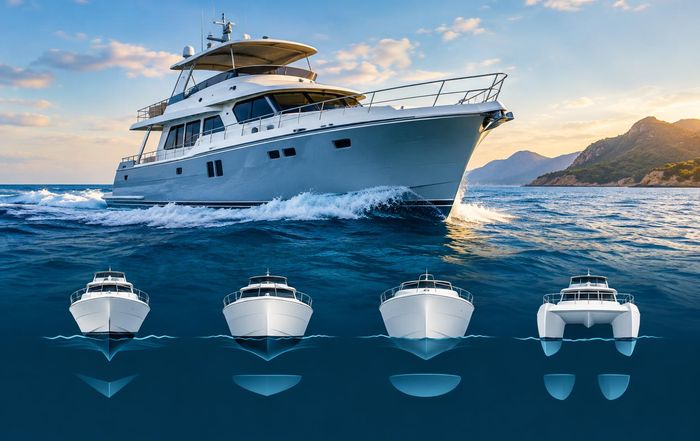
The Hull Shapes That Make Offshore Cruising More Comfortable
Comfort at sea begins long before the upholstery, stabilizers, or air conditioning come into play. For offshore cruising, hull shape is one of the biggest determinants of how a yacht behaves when the wind rises, the swell stretches out, and the boat has to keep moving for hours rather than minutes. The most comfortable hull is not always the fastest, the most fuel-efficient, or the one with the deepest draft. It is the one that best balances motion, stability, reserve buoyancy, and predictable handling for the kind of passages the owner actually intends to make. That balance is why serious buyers often study hull form as carefully as they study interior layout, and why a good review of a yacht should always consider the underlying shape as much as the visible design. For people exploring design questions, our pages around yacht design and boat reviews are useful places to compare how different builders interpret the same brief.
What "comfortable" really means offshore
Comfort offshore is partly subjective, but naval architects tend to think about it in measurable ways. A boat that slams less, rolls more slowly, tracks predictably, and recovers without dramatic corrections will usually feel easier to live with over a long passage. That matters because fatigue is cumulative: a hull that throws off a sharp motion in short chop may be tolerable for an afternoon, then exhausting by the second night at sea. Offshore comfort also depends on the loading condition of the yacht, the speed range at which it is operated, and whether the crew wants to motor, sail, or do both. A hull that is excellent in one regime may be mediocre in another, which is why there is no single "best" shape for every cruiser.
This is also where the difference between design theory and real-world use becomes important. A hull optimized for a light-displacement performance cruiser will feel very different from one drawn for a passagemaking trawler, even if both are marketed as offshore capable. The best starting point is to understand the main hull families and what each does well. For readers interested in the operational side of passage-making, the cruising section and sustainability coverage offer useful context on how owners are thinking about range, efficiency, and long-distance use in 2026.
Full-displacement hulls: steady, predictable, and often the easiest to live with
A full-displacement hull remains one of the most reassuring choices for comfortable offshore cruising, especially for owners who value smoothness over speed. These hulls are designed to move through the water rather than climb over it, which usually means a more even motion, especially in a seaway. Their fuller sections and relatively deep underwater volume can provide excellent directional stability and a sense of composure when conditions become less forgiving. For long passages at moderate speeds, that predictability is often what crews appreciate most.
The trade-off is obvious: full-displacement yachts are generally slower and may require more time to reach a destination, which can matter if weather windows are tight. They can also be less efficient if pushed beyond their intended speed range. Yet for many offshore cruisers, the appeal lies precisely in their ability to maintain a comfortable rhythm without constant throttle changes or dramatic trim adjustments. That is why this form remains common in serious passagemakers, expedition yachts, and larger cruising motor yachts. It is also a hull type that tends to pair well with the practical thinking found in business and global yacht-market coverage, where buyers often weigh operating costs, refit complexity, and long-term usability as carefully as aesthetics.
The most successful full-displacement cruisers are not simply "big and heavy." Good examples are carefully balanced, with enough beam for interior volume and stability, but not so much form drag that the yacht feels reluctant or inefficient. Their comfort comes from a combination of steady motion, reserve buoyancy, and a forgiving response to changing seas. For many owners crossing oceans or spending extended periods aboard, that is exactly the kind of comfort that matters.
Semi-displacement hulls: the compromise that suits many modern cruisers
Semi-displacement hulls sit between classic displacement and planing forms, and they are often the most practical answer for owners who want a yacht that can cruise efficiently at moderate speeds while still having the ability to increase pace when conditions and schedules allow. The comfort advantage here comes from versatility. A well-drawn semi-displacement hull can run efficiently at a range of speeds, without the abrupt transition and higher fuel demand associated with a planing boat trying to stay on top of the water.
This category has become especially relevant because many modern offshore cruisers do not want to be locked into a single operating style. They may want a relaxed passage one week and a faster repositioning run the next. Semi-displacement hulls can offer a useful middle ground, especially when paired with careful weight control and good seakeeping design. They are not always as serene at low speed as a full-displacement hull, and they may not be as efficient as some slower trawler-style boats, but they often provide the broadest "real-world" comfort envelope for mixed-use cruising.
Their suitability depends heavily on how the boat is engineered. Hull form, weight distribution, propulsion choice, and sea state all interact. A semi-displacement yacht with poor trim or excessive top weight can feel much less comfortable than its brochure suggests. That is why buyers should look beyond the headline speed figures and study the hull sections, fuel burn curves, and sea-trial data where available. For a broader view of how yacht engineering and materials are evolving, Yacht Review's technology section is a natural companion to this discussion.
Planing hulls: comfortable only when they are used in the right way
Planing hulls are often associated with speed, but not necessarily with comfort. Once on plane, they can feel lively and efficient, and in the right sea state they may actually reduce exposure to uncomfortable motion by shortening passage times. The challenge is that planing performance is highly dependent on speed, load, and sea conditions. In a short, steep chop, a planing hull can become tiring if it has to be driven hard to stay in its best operating range. If it is underpowered or overloaded, it may pound, roll, or lose the smoothness that makes planing attractive in the first place.
That does not mean planing hulls are poor offshore choices. It means they are best suited to owners who understand their operating window and choose the right size and power package. Larger planing yachts with refined hull geometry, good weight distribution, and proper trim control can be surprisingly comfortable at passage speeds, especially in relatively moderate conditions. But comfort is more conditional than with a slower displacement cruiser. The hull may be excellent for a fast crossing in good weather and distinctly less pleasant if the sea state deteriorates.
For offshore buyers, the key question is not whether a planing hull is inherently good or bad, but whether the intended cruising profile matches the design. If a yacht will spend much of its life at displacement-like speeds, it may not make sense to buy a form that only feels best when driven faster. That is one reason many buyers compare planing and semi-displacement options against news and reviews that include real operating impressions rather than relying on brochure performance numbers alone.
Round bilge, hard chine, and the shape of motion
Beyond the broad categories, the underwater section of the hull has a major effect on how comfortable a yacht feels. Round-bilge hulls are often praised for their softer motion, especially in a beam sea, because they tend to transition more gradually through the water. They can feel composed and predictable, which is one reason they remain respected in classic and contemporary cruising designs. Hard-chine hulls, by contrast, can offer greater form stability and more interior volume for a given beam, and in some modern designs they deliver excellent performance and surprisingly good seakeeping.
The comfort difference is not as simple as "round is better." A hard-chine hull can be very comfortable if it is properly designed, because the chine can help reduce rolling and improve stability at rest and underway. It can also make a yacht feel more secure when loaded for cruising. But an overly aggressive chine, or one paired with a narrow beam and poor weight distribution, can produce a motion that feels abrupt rather than gentle. Round bilge can soften that motion, yet if the boat is too tender or too heavily loaded high up, it may roll more than many owners want.
This is where naval architecture becomes as much art as engineering. Hull shape works in concert with beam, displacement, center of gravity, keel form, and appendages. A good offshore cruiser is rarely defined by one feature alone. For readers interested in how these design choices connect to ownership culture and long-term use, Yacht Review's history and boats sections help place current design trends in a longer context.
Beam, length, and why "more" is not always better
Beam contributes to comfort in ways that are easy to overlook. A wider hull can offer better initial stability, which helps reduce the feeling of tenderness when people move around on board or when the yacht is at anchor. It can also create more usable interior volume, which matters on long passages when life aboard becomes as important as the passage itself. But excessive beam can come with penalties. A very wide hull may present more surface to the sea, can increase drag, and may produce a motion that is abrupt rather than fluid if the rest of the geometry is not carefully balanced.
Length is equally important. Longer yachts generally have a longer natural period of motion, which often translates into a more comfortable ride in certain conditions. They also bridge waves more effectively, reducing the tendency to hobbyhorse. That is one reason many experienced offshore cruisers prefer a longer, moderately proportioned hull over a shorter, beamier one, even if the interior volume appears less dramatic on paper. The trade-off is cost, berth availability, and operating expense, all of which become more noticeable as size increases.
The right answer depends on the route and the crew. A yacht intended for high-latitude passages, ocean crossings, or extended liveaboard use may benefit from a more conservative proportioning strategy than a coastal cruiser that only occasionally ventures offshore. For owners comparing destinations and passage styles, Yacht Review's travel and family sections offer relevant perspective on how different layouts and hull choices affect life aboard in practice.
Catamarans and multihulls: exceptionally stable, but not universally calmer
Multihulls deserve a separate mention because many buyers now consider them for offshore cruising comfort. Catamarans are often extremely stable at rest and underway, which can make life aboard feel notably easier for families or guests who dislike heel. Their shallow draft also expands anchorage options, and their wide stance can provide excellent platform stability. For many people, that immediate steadiness is the most obvious form of comfort a yacht can offer.
Yet catamarans are not automatically more comfortable in every offshore condition. Their motion can be very different from that of a monohull, and some crews find the faster, more lateral movement in certain seas less agreeable. Bridge-deck clearance, weight distribution, and hull slenderness are critical. A poorly executed multihull can slam hard, especially if overloaded. A well-designed one can be exceptionally efficient and calm, but the comfort experience is highly dependent on the specific boat and the sea state. This is why multihull buyers should be cautious about broad claims and should rely on sea trials, independent reviews, and real-world cruising reports.
For the right owner, though, a catamaran can be one of the best hull forms for offshore comfort, particularly when stability at anchor and low-heel living matter as much as passage speed. That is especially relevant for cruisers who spend long periods aboard and want a home-like platform rather than a traditional yacht motion. The question is less whether catamarans are comfortable than what kind of comfort they deliver, and whether that aligns with the owner's expectations.
The details that matter as much as the hull form
Hull shape sets the foundation, but comfort offshore is also shaped by the details around it. A keel or skeg can improve tracking and directional stability. Properly sized bilge keels or chines can influence roll behavior. Propeller and shaft arrangement can affect vibration and noise. Even the distribution of tanks, batteries, and stores changes how the boat sits in the water once cruising gear is loaded aboard. A yacht that looks well balanced at the dock may behave very differently after fuel, water, tenders, and provisions are added.
This is also where modern systems can make a meaningful difference. Active stabilization, carefully tuned autopilots, and intelligent trim systems can improve comfort, but they cannot fully compensate for a hull that is fundamentally mismatched to its use. In other words, technology can refine a good design, but it rarely rescues a poor one. Buyers should treat these systems as enhancers, not substitutes, for sound naval architecture. That distinction matters even more as owners become more attentive to efficiency and emissions, a trend reflected in the growing attention to sustainability across the industry.
Choosing the right hull for the way you actually cruise
The best offshore hull shape is the one that matches the owner's genuine cruising pattern. A couple planning long, moderate-speed passages with an emphasis on quiet motion may be best served by a full-displacement or carefully designed semi-displacement yacht. An owner who wants flexibility, higher average speeds, and the ability to adapt plans quickly may prefer a semi-displacement form with good seakeeping credentials. A buyer prioritizing maximum stability at anchor and family-friendly living space may find a catamaran compelling, provided the motion profile suits them. A performance-minded cruiser may accept the compromises of a planing hull in exchange for speed and range at the right operating point.
What matters most is honesty about use. Offshore cruising is not a single category, and comfort is not a single sensation. Some yachts feel calm because they move slowly and steadily; others feel calm because they get the passage over with quickly; still others feel calm because they barely heel or roll at all. The best hull shape is the one that makes the kind of cruising you really want to do feel sustainable over many days, not just impressive in a sea trial. For readers following the wider market, Yacht Review's events and community content can also be useful for seeing how owners, builders, and designers are discussing these choices in the broader yachting world.
In the end, comfortable offshore cruising is less about chasing a fashionable hull profile than about understanding the trade-offs hidden in each form. That is why the smartest buyers spend as much time studying the underwater lines as they do the deck plan. The right hull does not just move through the sea; it shapes how the whole voyage feels.