

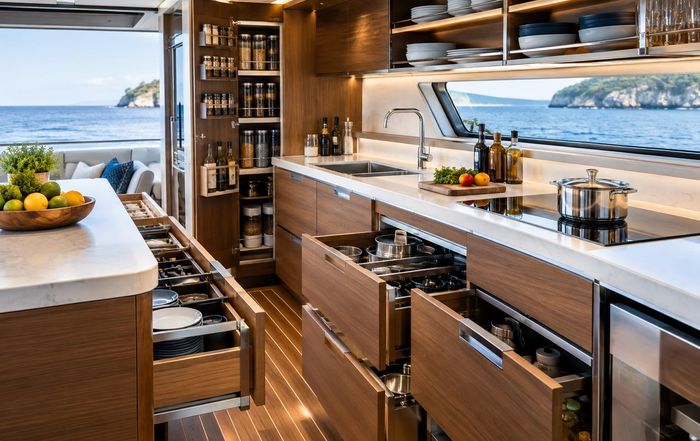
Luxury Yacht Galleys: Storage Ideas That Actually Work
A yacht galley has to do more than look polished in port. It needs to function at sea, often with limited square footage, movement under way, and a crew or owner who expects restaurant-level results from a compact space. That is why the best storage ideas are rarely the flashiest ones. They are the solutions that keep heavy items secure, protect delicate provisions, and make every inch of cabinetry, counter, and cold storage count when conditions change. On a well-designed yacht, storage is not an afterthought; it is part of the vessel's operating logic, closely tied to design, cruising, and even the way a boat is used for family travel.
The challenge is especially pronounced because a yacht galley must handle the same categories of storage that a land-based kitchen does, but with stricter limits on weight, vibration, humidity, and access. Fresh produce, dry goods, tableware, cookware, cleaning supplies, and spare consumables all need a place, ideally one that remains usable when the yacht heels, accelerates, or sits at anchor in warm weather. The most effective storage strategies therefore combine marine-grade joinery, smart compartmentalization, and a clear understanding of what should be kept close at hand versus what should be stowed deeper in the boat. For readers exploring broader vessel layouts, the related sections on boats and reviews can be useful context for how different yacht types approach the same problem in different ways.
Start with the galley's real job, not its square footage
The first mistake many owners make is treating yacht galley storage like a miniature version of a residential kitchen. In practice, the best arrangement begins with use pattern: how many people are usually aboard, whether the yacht is owner-operated or crewed, how often guests are entertained, and whether the boat is used for short coastal runs or longer passages. A weekend cruiser may need more flexible pantry space and easy access to entertaining ware, while an expedition-style yacht may require deeper stores, more refrigeration, and better segregation of spares. That distinction matters because storage that looks efficient on paper can become awkward if it forces the cook to repeatedly move between the galley, saloon, and service areas during meal preparation.
This is where good layout thinking overlaps with broader interior planning. A yacht that has been designed with a coherent flow between lifestyle, travel, and onboard service tends to support better storage decisions from the outset. The most useful question is not "Where can we fit more cabinets?" but "What needs to be reachable in three seconds, what can be secured for passage, and what can be stored below without slowing service?" Once that hierarchy is clear, the storage plan becomes much easier to execute. It also reduces the temptation to overfill every compartment, which is one of the fastest ways to make a galley feel smaller and less efficient than it really is.
Use vertical space without making the room feel crowded
Vertical storage is one of the most reliable ways to gain capacity in a yacht galley, but it has to be handled carefully. Tall lockers, slim pantry towers, and wall-mounted racks can all work well if they are integrated cleanly into the joinery and do not create visual clutter. The best examples use a mix of concealed cabinetry and selective display, so the space remains calm rather than busy. Deep upper cabinets can be useful for lightweight items such as linens, extra glassware, or infrequently used serving pieces, while lower and mid-height compartments should carry the heavier load. On a moving vessel, anything stored high must be restrained properly, and doors should open in a way that does not block circulation or create a hazard.
There is also a design advantage to verticality when it is done well. A yacht interior that uses height intelligently can feel more spacious because the eye reads the cabinetry as part of a continuous architectural envelope rather than as scattered storage boxes. That principle is especially relevant in compact galleys where every line matters. Publications such as Boat International, Yachting, and the broader industry coverage from the Superyacht Times often show how experienced interior teams use vertical elements to improve both function and proportion. The lesson is simple: storage should rise with the space, not fight against it.
Prioritize modular compartments over one large pantry
One large pantry may sound luxurious, but in practice modular storage usually works better on board. Separate bins, adjustable shelves, pull-out drawers, and removable inserts keep provisions organized and easier to inventory. This matters because yacht provisioning is rarely static. Supplies may be loaded for a week, then topped up in port, then reorganized again after a guest trip. A modular system allows the crew or owner to adapt without dismantling the whole arrangement. It also helps avoid the common problem of forgotten items disappearing into the back of a deep cupboard.
For dry stores, clear containers and labeled zones can make a remarkable difference, especially when the yacht carries a wide range of specialty ingredients or dietary alternatives. For liquor, snacks, and breakfast items, shallow pull-out trays often work better than fixed shelves because they reduce reach and improve visibility. For those interested in how storage intersects with onboard systems and service efficiency, the technology section is a natural companion, particularly where refrigeration, monitoring, and power management affect how food is stored and accessed. The real advantage of modularity is not simply orderliness; it is resilience. A galley that can be reconfigured quickly is much easier to live with over time.
Make refrigeration and cold storage part of the plan from day one
Cold storage is often where yacht galleys succeed or fail. It is tempting to focus on cabinetry first and refrigeration later, but on a yacht the two are inseparable. Refrigerator drawers, upright fridges, freezer capacity, wine storage, and chilled drawers all need to be planned around actual usage rather than assumed luxury. A vessel that entertains frequently may need better separation between daily-use refrigeration and reserve stores. A yacht used for longer passages may need more robust freezer volume and a layout that supports batch provisioning. In either case, access matters as much as capacity. If the coldest compartments are awkward to reach, they will be underused or poorly organized.
Energy efficiency is another reason to treat refrigeration as a storage strategy rather than a standalone appliance choice. Marine systems must balance cooling performance with electrical demand, ventilation, and heat management in a confined space. For that reason, credible guidance from organizations such as the U.S. Coast Guard, the National Marine Manufacturers Association, and classification bodies like Lloyd's Register can be useful background when owners are evaluating equipment or retrofit decisions. Even when the exact setup varies, the principle stays the same: cold storage should be easy to load, easy to inspect, and designed to protect both food quality and onboard efficiency.
Build in secure storage for movement, not just for aesthetics
A yacht galley that looks immaculate at anchor can become frustrating underway if drawers slam, bottles rattle, and crockery shifts. Secure storage is therefore a core design requirement, not an optional upgrade. Positive latches, deep drawer runners, non-slip liners, and restrained shelving are all practical features that make a major difference at sea. The best systems do not merely stop items from moving; they make it intuitive to return things to their correct place after use. That reduces noise, damage, and the chance of breakage during rougher passages.
This is also where material choice matters. Lightweight crockery, stackable cookware, and marine-suitable containers can dramatically reduce stress on both storage and structure. Heavy items should be kept low and near the centerline when possible, both for safety and for ease of handling. If the yacht is set up for guest service, it is worth separating everyday service ware from special-event pieces so that the most frequently used items are accessible without exposing the entire inventory to unnecessary handling. For broader context on vessel operations and the practical realities of keeping a yacht functional, the business section can be surprisingly relevant, because interior decisions often affect operating costs, maintenance, and crew workload.
Think in zones: prep, cook, serve, clean, store
The most effective yacht galleys operate as a sequence of zones rather than a single room full of cabinets. Prep ingredients should live near work surfaces; cookware should be close to the hob or induction area; plates and glassware should be near service points; and cleaning supplies should be isolated but not buried. When storage follows this logic, the galley becomes faster to use and less stressful to maintain. It also reduces cross-traffic, which is especially important when several people are moving through a compact interior during meal service.
Zone planning is one reason professional yacht interiors often feel so effortless compared with improvised retrofits. A good designer will think through the relationship between the galley and adjacent spaces, including the dining area, crew passageways, and exterior entertaining zones. That broader approach is common in the more carefully documented examples found in design coverage, where cabinetry, appliances, and circulation are treated as one system rather than separate decisions. A storage plan that respects workflow will usually outperform one that simply maximizes volume. In a yacht galley, convenience is capacity.
Use hidden storage for the items you need but do not want to see
Luxury does not always mean visible abundance. In many yachts, the smartest storage is concealed: appliance garages, flush-panel drawers, toe-kick compartments, and integrated niches that keep the galley visually calm. Hidden storage is especially valuable for items that are necessary but not attractive, such as cleaning products, spare linens, water filters, or backup utensils. It can also help preserve the design language of the interior, particularly in open-plan yachts where the galley is partially visible from the saloon. When the eye is not constantly drawn to clutter, the space feels more refined and more spacious.
That said, hidden storage only works if access remains practical. Deep concealed compartments should be reserved for items that are used less frequently, while daily necessities need simple retrieval. It is easy to overdo the minimalist look and end up with storage that is elegant but inconvenient. The best hidden solutions are the ones that disappear when closed and behave predictably when opened. For readers interested in how that balance plays out across different yacht types and eras, history offers useful perspective on how galley layouts have evolved from purely utilitarian spaces into highly engineered interiors.
Materials, maintenance, and humidity matter more than many owners expect
A storage system on land can survive a little abuse; on a yacht, it has to survive humidity, salt air, vibration, and repeated cleaning. That means marine-grade finishes, corrosion-resistant hardware, and surfaces that can be wiped down quickly without damage. Soft-close fittings and premium joinery are useful, but they should be chosen for durability as much as refinement. If a hinge or runner fails in a damp environment, the whole storage concept can unravel quickly. This is why owners planning a refit or new build should consider long-term maintenance alongside appearance.
Humidity control is especially important for pantry items, paper goods, and wooden accessories. Even well-designed storage can be compromised if ventilation is poor or if condensation builds in enclosed compartments. In warmer cruising grounds, this becomes even more relevant, particularly for yachts that spend long periods away from a marina. Responsible operating practices, along with industry guidance from sources such as the International Maritime Organization and the Royal Yachting Association, reinforce the broader point that onboard systems should be built for real conditions, not showroom conditions. Good storage is partly about carpentry, but it is also about environment management.
The best upgrades are often the least dramatic
Owners sometimes imagine that better galley storage requires a full redesign, but many of the most effective improvements are incremental. Replacing awkward shelves with pull-outs, adding drawer dividers, standardizing containers, improving labeling, and rethinking where heavy items live can transform the day-to-day experience of using the space. Even a modest yacht can feel more capable when storage is rationalized. On larger yachts, those same adjustments can reduce crew fatigue and improve service consistency, which is why they are often part of serious interior planning rather than cosmetic tweaks.
The most successful luxury yacht galleys do not simply store more; they store better. They keep the right items close, the wrong items out of the way, and the whole space stable enough to function at sea without constant correction. That is the real measure of good galley storage: not how impressive it looks in a still photograph, but how calmly it performs when the yacht is underway, guests are aboard, and the schedule is tight.